
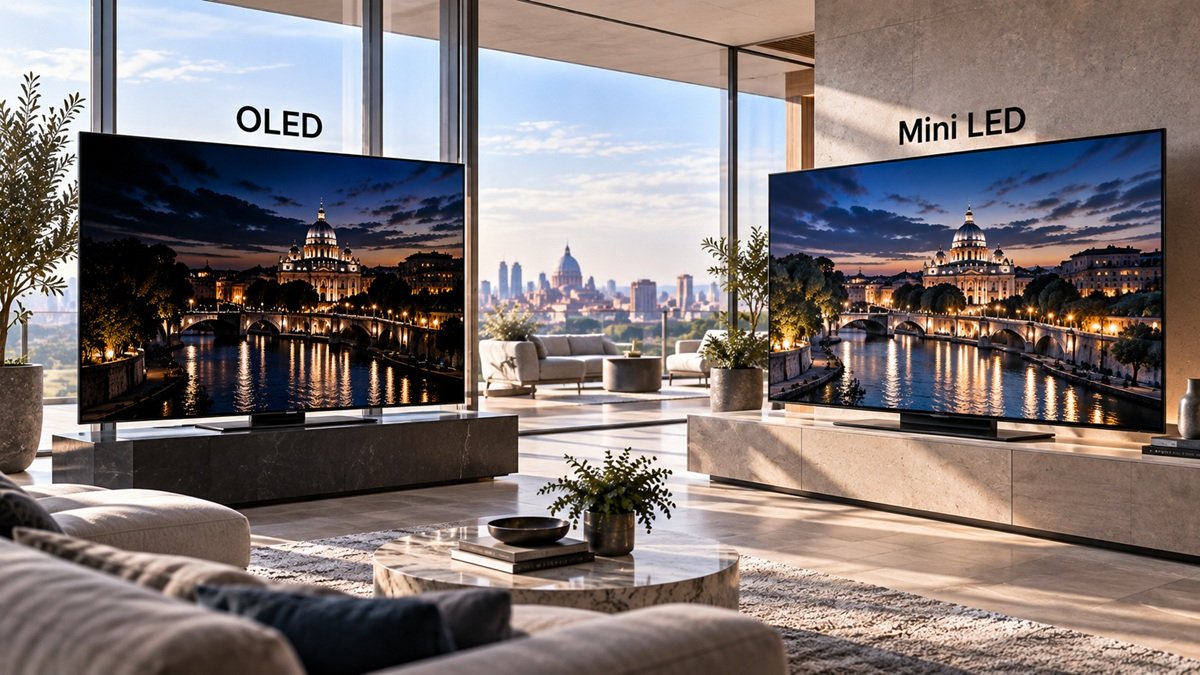
OLED vs Mini LED TVs: Where Each One Wins
Last updated: September 2026
🕒 8 min read
Disclosure: This article does not contain affiliate or sponsored links. SignalVetted may still reference specific products or brands for informational purposes only.
The usual advice on OLED vs Mini LED TVs fits in one line: OLED for dark rooms, Mini LED for bright rooms. It is a decent starting point, but it hides how close the black-level race has become and where the tested OLED actually beat the tested Mini LED on brightness. This page goes through RTINGS’ Mini LED vs. OLED comparison test by test. For the wider picture of how OLED TVs perform, our full OLED TV guide covers that separately.
Table of Contents
OLED vs Mini LED TVs: OLED in the Dark, Mini LED for Brightness
RTINGS’ conclusion is that OLEDs are still the undisputed kings of dark-room performance, especially against mid-range and budget Mini LEDs, and that Mini LEDs still tend to be the best choice for bright-room viewing most of the time. That is RTINGS’ verdict; this page is a synthesis of it, not our own lab testing. RTINGS names OLED the winner on contrast, lighting zone precision, black uniformity, viewing angle, gray uniformity, and response time. It names Mini LED the winner on brightness. Longevity is a tie.
Our verdict, based on RTINGS’ comparison
Winner, by viewing condition: OLED for dark-room performance and most picture-quality tests; Mini LED for brightness and bright-room viewing “most of the time,” per RTINGS.
Why: OLED wins most of RTINGS’ tests, Mini LED wins brightness, and longevity is a tie.
Exceptions: very bright scenes such as sports favor Mini LED. A specific model can break the pattern, so check the measurements for the TV you are considering.
Two notes on scope. First, RTINGS says “Mini LED” means very little as a category: there is no set definition, and most TVs marketed as Mini LED in 2025 had at least decent local dimming with a few hundred zones. So every Mini LED result below describes one model, not the whole label. Second, this is the general comparison. If you are weighing a specific brand, our look at whether a TCL Mini-LED matches OLED covers that separately, and this page reviews no TCL model.
Micro LED is a different technology: a Mini LED TV is still an LED-backlit LCD, while Micro LED sets use LEDs as the pixels themselves. That is our general explanation, not from RTINGS, and Micro LED vs. OLED is a separate comparison.
What Each Technology Is
An OLED lights each pixel individually, so a pixel can be fully off next to a very bright one. A Mini LED TV lights an LCD panel from behind with LEDs grouped into dimming zones, and the LCD layer filters that light.
For the underlying OLED technology, our explainer on what OLED TV technology actually is goes further.
RTINGS also notes two OLED sub-types, WOLED and QD-OLED, which differ in how they produce color; our explainer on OLED panel types covers that, and the QD-OLED vs. WOLED comparison is a separate page, not published yet.
The QD-OLED vs. WOLED comparison is a separate page.
The Test Behind These Numbers
Most figures here come from one RTINGS pairing: the Sony BRAVIA 9, a Mini LED, against the LG G5, a WOLED, both 2025 flagships. These are RTINGS’ example models, not statements about either brand. RTINGS describes them as two of the best TVs available on the market in 2025 and says other Mini LEDs will not look as good as the BRAVIA 9. Where RTINGS uses market-wide charts instead, we say so. The comparison dates from November 2025.
Category by Category
| Category | RTINGS’ result | Sony BRAVIA 9 Mini LED vs. LG G5 OLED |
|---|---|---|
| Contrast | OLED | 292,950:1 vs. Inf:1 |
| Lighting zone precision | OLED | 9/10 vs. 10/10 |
| Black uniformity | OLED | Std. dev. 0.270% vs. 0.110% |
| Brightness | Mini LED (market-wide charts) | HDR hallway scene: 802 vs. 1,120 cd/m² |
| Viewing angle | OLED | Color washout at 32° vs. 60° |
| Gray uniformity | OLED | 50% gray std. dev. 3.729% vs. 1.424% |
| Response time | OLED | Average CAD at 120Hz: 348 vs. 49 |
| Longevity | Tie | Different weak points |
Black Levels: OLED Wins, but the Gap Is Small in Contrast
RTINGS tests black levels three ways. On contrast, the BRAVIA 9 measured 292,950:1 against infinite for the G5. RTINGS says the two looked nearly identical around the cave opening, apart from a slight bluish glow in the BRAVIA 9’s darkest areas, and still names OLED the winner. Lighting zone precision, which shows how well a TV dims around odd shapes such as subtitles, scored 9/10 for the BRAVIA 9 and 10/10 for the G5.
RTINGS notes that no TV has enough dimming zones to dim precisely around text, so the BRAVIA 9 shows a halo there, and it calls the result “no contest”: OLEDs are simply better. On black uniformity, the standard deviation was 0.270% for the BRAVIA 9 against 0.110% for the G5; most Mini LEDs do well here, RTINGS says, but OLEDs can turn dark pixels off completely.
The halo RTINGS describes here is the kind of blooming or haloing that local dimming can cause. Our explainer on what local dimming is covers that trade-off in plain terms.
RTINGS combines the three into a black-level score in which every OLED scores a perfect 10. More dimming zones usually help, but its chart is very noisy, and it says the algorithms that control the zones matter far more than the zone count. Its overall read: Mini LED is getting much closer but still has a way to go, with significant haloing on many models.
Brightness: Mini LED Wins on the Charts, Not in This Pair
Here the tested pair is the exception. In the HDR hallway scene the G5 measured 1,120 cd/m² against 802 for the BRAVIA 9, so the OLED was brighter than this Mini LED. RTINGS warns that one scene does not show how the technologies compare. Across the 45 Mini LEDs and OLEDs it tested, Mini LEDs were on average brighter than OLEDs. On a 100% brightness window, which represents the brightest content such as sports, RTINGS says there is really no contest: even the dimmest Mini LED it tested is brighter than the vast majority of OLEDs. For a bright living room, that is the strongest point in Mini LED’s favor.
Colors
RTINGS looked at color with a three-way comparison that includes a QD-OLED. Most Mini LEDs and QD-OLEDs use quantum dots and produce very pure primary colors, while WOLEDs are noisier. Across RTINGS’ chart of color coverage, WOLED and Mini LED were fairly evenly matched, with Mini LED slightly higher on average but with a lower low end, because Mini LED models vary a lot. RTINGS’ color winner is QD-OLED, a separate topic from this page.
Viewing Angle and Uniformity
Viewing angle is one area where RTINGS says OLEDs are far superior and unlikely to change soon: color washout began at 32° for the BRAVIA 9 against 60° for the G5, and QD-OLED did better still. On gray uniformity, the BRAVIA 9’s 50% gray screen had a standard deviation of 3.729% against 1.424% for the G5, and looked patchier, which RTINGS says is mostly noticeable with sports. Uniformity varies between individual units.
Response Time: OLED, by a Wide Margin
At 120Hz, RTINGS measured an average CAD of 348 for the BRAVIA 9 and 49 for the G5. RTINGS says all OLEDs can switch from one shade to the next nearly instantly, which matters most for gaming at 120Hz or higher. RTINGS adds that the BRAVIA 9 is one of the worst Mini LEDs it has tested for response time, but that even the best Mini LED falls far short of even the slowest OLED.
Longevity and Cost
RTINGS calls longevity a tie. All OLEDs can eventually burn in when the same static elements are shown for long periods, though that could take years. Mini LEDs do not burn in, but their backlight LEDs can fade over time, lowering peak brightness, and the panel can develop uniformity issues.
On cost, RTINGS says there is a huge range of Mini LED TVs at many prices and sizes and you usually get what you pay for. It adds that those able to compete with OLED in a dark room tend to be on the pricier side, and that OLEDs tend to start higher. We do not quote prices, since they change.
Scenario-Based Guidance
If you watch mainly in a dark or dim room, RTINGS’ black-level, uniformity and viewing-angle results favor OLED. In a bright room, or with a lot of sports, RTINGS says Mini LEDs are usually the better choice. For gaming at 120Hz or higher, OLED’s response time is a clear advantage. And on a tight budget, the widest choice of prices and sizes is in Mini LED, though performance varies widely.
Common Misconceptions or Mistakes
A common misconception is that “Mini LED” is a defined performance tier. RTINGS says the term has no set definition, so two Mini LED TVs can perform very differently.
A second is that an OLED can never be brighter than a Mini LED. In this comparison the G5 was brighter than the BRAVIA 9 in the hallway scene, although Mini LEDs are brighter on average and on very bright scenes.
A third is that more dimming zones always mean better blacks. RTINGS found that more zones usually help but the chart is very noisy, and says the zone-control algorithm matters more than the zone count.
Frequently Asked Questions
Is Mini LED as good as OLED?
In RTINGS’ 2025 comparison, not in dark-room picture quality: OLED won most tests, Mini LED won brightness, and RTINGS says Mini LED is getting much closer on black levels.
Is Mini LED better for a bright room?
RTINGS says Mini LEDs still tend to be the best choice for bright-room viewing most of the time. Even so, its tested OLED was brighter than its tested Mini LED in one scene, so check the specific model.
Which is better for gaming?
RTINGS’ response-time result favors OLED: at 120Hz, the G5 measured an average CAD of 49 against 348 for the BRAVIA 9. RTINGS says this matters most when gaming at 120Hz or higher.
Are these results true for every OLED and Mini LED TV?
No. They come from one pairing, and RTINGS says other Mini LEDs will not look as good as the BRAVIA 9. “Mini LED” has no set definition, so one model’s results do not describe the label.
Whichever way you lean, panel type is only a starting point: look at how the specific TV performs.

Nridi
Editor, SignalVetted
SignalVetted has not independently tested these products.
✅ Based on RTINGS.com’s independent Mini LED vs. OLED comparison (Sony BRAVIA 9 vs. LG G5).