
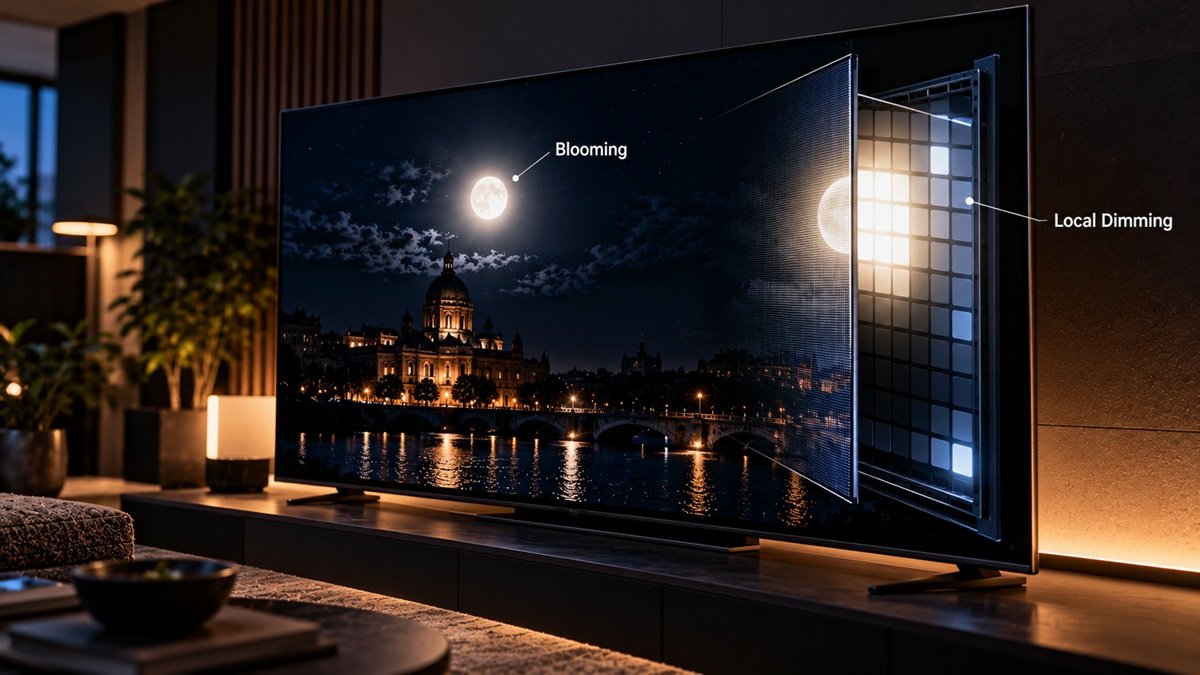
What Is Local Dimming? (And Why It Causes Blooming)
Last updated: September 2026
🕒 3 min read
Disclosure: This article does not contain affiliate or sponsored links. SignalVetted may still reference specific products or brands for informational purposes only.
If you’ve seen “local dimming” listed as a TV spec or setting, it’s a backlight feature — and, like most picture-quality features, it comes with a trade-off worth understanding before you rely on it.
Table of Contents
What Is Local Dimming? The Short Answer
According to RTINGS, local dimming can improve contrast when implemented correctly, but it often causes artifacts such as blooming or haloing around bright highlights. In other words: it’s a backlight feature aimed at making dark scenes look darker and bright scenes look brighter, at the same time — and it doesn’t come free.
If the terms backlit LED/LCD are new, our explainer on what an LED LCD TV is covers the basics.
The Trade-Off: Blooming and Haloing
That same RTINGS testing page names the specific downside: blooming and haloing, meaning a faint glow or halo can appear around bright objects sitting on a dark background — a bright star field against a black night sky is the classic example. RTINGS’ finding is direct: local dimming helps contrast when it’s implemented well, but the artifact risk comes with it.
For more on contrast, see our explainer on what contrast on a TV is.
Why OLED TVs Don’t Need It
Local dimming exists to work around a limitation of backlit LED/LCD TVs, which need a separate light source behind the panel. OLED TVs don’t have that problem in the first place — as we cover in our explainer on OLED TV technology, each pixel in an OLED panel produces its own light and can turn off completely, so there’s no backlight to manage in the first place.
That’s also why OLED doesn’t have blooming or haloing the way local-dimming TVs can — see our breakdown of OLED panel types for more on how that self-emissive design works across different OLED variants.
Frequently Asked Questions
Does local dimming mean a TV has good contrast?
Not automatically. RTINGS’ own testing finds that local dimming improves contrast “when implemented correctly” — meaning the quality of the implementation matters, and the same feature can still introduce blooming or haloing around bright highlights even on a TV that has it.

Nridi
Editor, SignalVetted
This article does not report independent product testing.
✅ Based on RTINGS’ picture-quality testing.