
What Is OLED TV Technology?
Last updated: September 2026
🕒 7 min read
Disclosure: This article does not contain affiliate or sponsored links. SignalVetted may still reference specific products or brands for informational purposes only.
Every pixel in an OLED TV makes its own light, and that single fact explains almost everything else about how the technology behaves. If you’ve run into the term “OLED” while researching a new TV and want to know what is OLED TV technology actually doing differently from the LED or LCD set you might already own, this is the plain-mechanism explanation — not a buying recommendation, just what’s actually happening behind the screen. For a full look at where OLED sits price-wise once you understand the mechanism, our full OLED TV guide covers the current lineup separately from this explainer.
Table of Contents
What Is OLED TV Technology, Actually?
OLED stands for Organic Light-Emitting Diode. In a standard LED or LCD TV, a backlight sits behind the entire panel and shines through a liquid-crystal layer that twists to let more or less light through at each point — the panel is controlling how much of a constant light source gets blocked, not generating light itself at the pixel level.
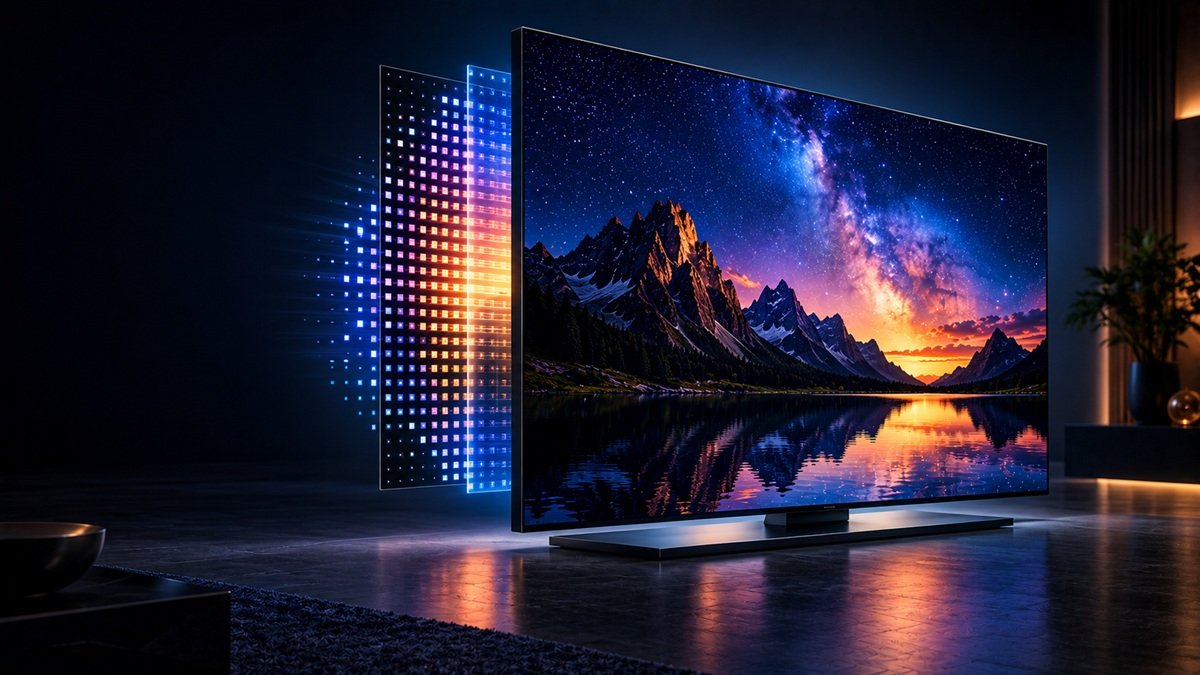
An OLED panel works differently: each individual pixel is its own tiny light-emitting element, built from an organic compound that produces light when current runs through it, a mechanism explained in RTINGS’ guide to OLED panels. There’s no separate backlight to speak of, because the pixels themselves are the light source. For a closer look at the pixel layers and how they emit light, see our guide on how OLED TVs work.
That single structural difference is the answer to the core question. Everything else this article covers — true blacks, wide viewing angles, fast response, and the burn-in trade-off — traces back to the fact that OLED pixels emit their own light individually, while LED/LCD pixels only filter light from a shared source behind them. A shallow definition would stop there. What actually matters for a reader deciding whether any of this affects them is that the same mechanism responsible for OLED’s picture-quality strengths is also directly responsible for its one real weakness — they’re not two separate topics, they’re the same fact viewed from two angles.
What Is OLED TV Technology Doing at the Pixel Level?
Per-pixel emission and true black levels
Because each OLED pixel makes its own light, any pixel that needs to show black can simply switch off completely — no light emitted, no light to block. A backlit LED or LCD panel can only approximate this by dimming clusters of pixels at once (local dimming), and even a well-tuned implementation is still controlling groups rather than single pixels, so a small bright object against a dark background will show some light bleeding into the surrounding area that’s supposed to be black. OLED sidesteps that problem entirely, since there’s no shared backlight for one pixel’s brightness to leak into its neighbor’s darkness.
That same per-pixel independence is also why OLED holds up well when you’re not sitting directly in front of it: with no backlight pushing through stacked filtering layers on its way to your eyes, the picture stays consistent well off to the side, instead of washing out the way many backlit panels do at an angle. Our explainer on OLED panel types goes further into how different OLED panel constructions (like WOLED and QD-OLED) build on this same base mechanism differently.
Response time and motion handling
Pixel response time is the other characteristic that traces back to self-emission. Based on manufacturer specification data, an OLED pixel can change brightness essentially instantly, because there’s no physical liquid-crystal layer that has to physically twist into a new position the way an LCD pixel’s does. In practice, that shows up as motion that stays sharp without the smearing or trailing that can appear on slower-responding panels, and it’s part of why OLED can render fine shadow detail and fast motion at the same time without one undermining the other.
What This Means for Different Readers
If you’re mainly trying to understand whether OLED’s picture-quality strengths would actually matter to you day to day, the self-emissive mechanism above is the part worth remembering: it’s a structural property of the panel, not a marketing claim layered on top of ordinary hardware, and it’s consistent across every OLED TV regardless of brand.
If you’re further along and weighing whether OLED specifically is worth its price premium and the burn-in trade-off covered below for your own viewing habits, that’s a separate, more specific question this explainer doesn’t try to answer on its own — it’s a value judgment, not a mechanism question.
And if you’re wondering how long an OLED panel’s picture quality actually holds up under years of real ownership, that’s a longevity question distinct from the burn-in mechanism explained here — burn-in is one specific risk pattern, not the same thing as overall panel lifespan. Our guide to how long OLED TVs actually last covers that question in the depth this explainer’s scope doesn’t allow.
Common Misconceptions or Mistakes
Not every claim about burn-in holds up, and this is the one most worth correcting: the idea that any OLED TV will inevitably burn in under ordinary use. That’s an overcorrection from a real but narrower fact. Each OLED pixel generates its own light independently, which is also the reason burn-in exists at all: hold identical, high-brightness content on the exact same pixels for long enough, repeated over and over, and those pixels wear down unevenly relative to their neighbors, eventually leaving a faint trace of whatever was shown there that doesn’t go away.
That’s a genuine, non-zero property of emissive-pixel displays, not an outdated myth — a finding RTINGS’ own burn-in testing confirms. But it only shows up under a narrow set of conditions: think a news channel running the same fixed logo and ticker for hours on end, a video-game HUD that stays parked in the same corner through marathon sessions, or a TV pressed into service as an always-on desktop monitor with a static taskbar. Switch between movies, sports, and streaming shows the way most households actually watch, and the picture never holds still long enough to create the kind of sustained, unchanging image that risk depends on.
For a fuller treatment of what causes it and how to reduce it in practice, our guide to preventing OLED burn-in covers the specifics this explainer’s scope doesn’t. For a closer look at how that trade-off weighs against OLED’s price premium specifically, our investigation into whether OLED is worth it in 2026 takes on that value question directly.
A second common mistake is treating “OLED” as if it describes one single, identical panel across every brand and model. The self-emissive mechanism explained above is shared by every OLED panel, but the processor, refresh-rate ceiling, and additional picture-processing features built on top of that shared foundation vary meaningfully between manufacturers and tiers — the mechanism is common ground, not a guarantee that every OLED TV performs identically.
Frequently Asked Questions
What is OLED TV technology, in one sentence?
OLED (Organic Light-Emitting Diode) TV technology uses pixels that each produce their own light and can switch off completely, rather than relying on a shared backlight filtered through a liquid-crystal layer the way LED and LCD TVs do.
Does OLED TV technology always cause burn-in?
No. Burn-in is a real, non-zero property of emissive-pixel displays, but it mainly shows up with a handful of fixed-image use cases — a static logo, a locked-in HUD, an always-on desktop — and stays rare for everyday viewing like movies, shows, and streaming.
Is OLED the same thing as QLED?
No. QLED is built on a backlit LCD structure with a quantum-dot filter layer added in front of it, while OLED’s pixels emit their own light directly with no backlight at all — they’re different panel architectures, not two names for the same technology.

Nridi
Editor, SignalVetted
This article does not report independent product testing.
✅ Based on manufacturer specification data and general display-technology characteristics.