
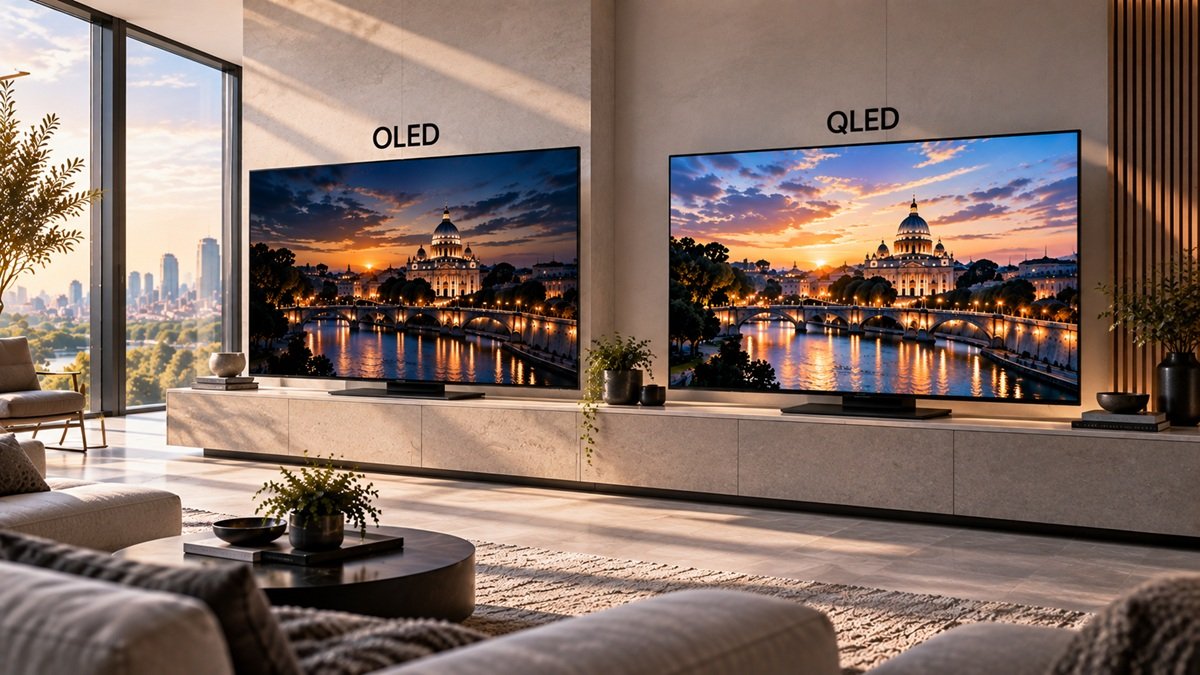
OLED vs QLED: No Single Winner, Here’s How to Choose
Last updated: September 2026
🕒 8 min read
Disclosure: This article does not contain affiliate or sponsored links. SignalVetted may still reference specific products or brands for informational purposes only.
Two premium labels, both sold on picture quality, and the price gap between them is real. If you are weighing OLED vs QLED, you have probably noticed that advice online contradicts itself. The most useful source we found is RTINGS’ own head-to-head comparison, and its headline is unusually candid: there is no clear winner. This page walks through RTINGS’ results category by category, marks where each technology wins, and shows where the answer depends on your room, your content, and the specific TV.
Table of Contents
OLED vs QLED: Each Wins Different Categories
RTINGS concludes that OLED and QLED each have real strengths and weaknesses, and that OLED is usually the way to go in a dark room but is not necessarily the best choice for everyone. That is RTINGS’ verdict; this page is a synthesis of it, not our own lab testing. In RTINGS’ results, OLED wins contrast, uniformity, and response time. Brightness depends on the specific model. Colors are labeled a QLED win (RTINGS’ label; its text says no clear winner), though the OLED in the test actually came out ahead. Longevity is a tie, and QLED is the cheaper option.
Our verdict, based on RTINGS’ comparison
Overall winner: none. RTINGS: “there’s no clear winner.”
By category: OLED for contrast, uniformity, and response time; colors are labeled QLED but RTINGS says there is no clear winner; QLED for price; brightness depends on the model; longevity is a tie.
Conditions: dark room, OLED. Very bright scenes such as sports, most QLEDs are significantly brighter (RTINGS). Very static content, QLED is probably safer. Tight budget, QLED.
Scope, and What Each Technology Is
A note on scope first. RTINGS tested two 2025 flagships, the Samsung QN90F (a QLED) and the LG G5 (an OLED), and its comparison covers WOLED-type OLEDs only, leaving out QD-OLED. We follow that scope. Everything here is one pairing, not a category average, although RTINGS says most of its findings remain valid for any WOLED or QLED. The page was updated in March 2026 but uses 2025 models. If you want to see how the OLED types differ, our explainer on OLED panel types covers that.
Our QD-OLED vs. WOLED comparison covers the two OLED types head to head.
In short, an OLED lights each pixel individually. A QLED is an LED-backlit TV with quantum dots added to produce color more efficiently, according to RTINGS: rather than filtering white light, quantum dots convert light to a purer wavelength, allowing a wider color range. For the underlying OLED technology, our explainer on what OLED TV technology actually is goes further.
Category by Category
| Category | RTINGS’ result | LG G5 OLED vs. Samsung QN90F QLED |
|---|---|---|
| Contrast | OLED | Inf:1 vs. 135,367:1 |
| Brightness | Depends on the model | HDR hallway scene: 1,120 vs. 1,019 cd/m² |
| Colors | QLED (RTINGS label; text: no clear winner) | BT.2020 coverage: 70.17% vs. 61.31% |
| Uniformity | OLED | 50% gray deviation: 1.424% vs. 1.972% |
| Response time | OLED | Average CAD at 60Hz: 66 vs. 255 |
| Longevity | Tie | Different weak points |
Contrast: OLED, With a Narrowing Gap
The LG G5 measured infinite contrast, since each pixel can switch fully off, against 135,367:1 for the Samsung QN90F. RTINGS names OLED the winner, and says OLEDs are the better choice for dark-room viewing. It also says QLEDs with local dimming have significantly narrowed the gap, and that some models from competing brands deliver nearly perfect contrast. Even so, RTINGS points to unavoidable downsides for backlit sets: a halo effect around bright highlights or subtitles, and distracting flicker when bright lights move across dimming zones. How backlight technology affects this is a separate question, which we cover in our OLED vs. Mini LED comparison.
Brightness: It Depends on the Model
RTINGS’ label here is that no panel type is inherently brighter. In the HDR hallway scene, the OLED measured 1,120 cd/m² against 1,019 for the QLED, so the OLED was slightly brighter than this QLED. But RTINGS adds that QLEDs are, on average, slightly brighter than most WOLEDs on the market in 2025, and that OLEDs have gotten brighter in recent years thanks to newer technology. The exception is very bright scenes: OLEDs drop off in brightness there, so for a sports fan, most QLEDs are significantly brighter. RTINGS’ advice is to check the measurements for the specific model rather than pick by panel type.
Colors: RTINGS’ Label vs. the Tested Pair
This is the most confusing category, so it is worth being precise. RTINGS labels colors a QLED win, yet its text says there is no clear winner and that it depends more on the specific type of WOLED or QLED. Its chart shows OLED and QLED performing roughly the same, with QLEDs slightly better on average. But in the tested pair, the LG G5 covered 70.17% of the BT.2020 color space against 61.31% for the Samsung QN90F, so the OLED was ahead.
RTINGS attributes that to the new RGB tandem panel introduced on the G5 in 2025, and says most OLEDs have a noisier color spectrum than the G5. RTINGS also says QLED quality varies, since some models use simpler designs to save costs. In our reading, the label reflects averages, and the tested pair is the exception.
Uniformity: OLED, Usually
The G5’s 50% gray screen deviated by 1.424% against 1.972% for the QN90F, meaning a smaller spread in brightness across the screen. RTINGS says OLEDs are almost universally better here, and that the vast majority beat average QLEDs across 41 TVs. It is careful to add that OLEDs are not perfect, and that other uniformity issues, such as a green tint, affect them.
Response Time: OLED, With a Catch for Movies
The G5 measured an average CAD at 60Hz of 66 against 255 for the QN90F. RTINGS says OLEDs are significantly better than even the fastest QLEDs, and that OLED is definitely the way to go for gamers. The catch is that this quick response also makes stutter more noticeable when watching movies. If film is your main use, see our guide to the best OLED TVs for movies.
Longevity and Cost
RTINGS rates longevity a tie. Its tests show all OLEDs can eventually burn in when the same static elements are shown for long periods, though that could take years, and varied content is unlikely to cause problems. QLEDs are not immune: RTINGS found the quantum dots themselves have a limited life span, and one QLED in its longevity test showed worse uniformity as the dots degraded. For gamers or people who watch the same channels all the time, RTINGS says a QLED is probably the safer choice.
On cost, OLEDs tend to have higher median prices and start at a higher price point. QLEDs have a lower median price and a wider spread, from cheap entry-level models up to 8K panels. RTINGS’ own advice is that QLED is the way to go if you are looking for something cheap. We do not quote prices here, since they change.
Scenario-Based Guidance
If you watch mostly in a dark or dim room, contrast and uniformity favor OLED in RTINGS’ results. If you watch a lot of sports in a bright room, RTINGS says most QLEDs are significantly brighter on very bright scenes, so check the brightness measurements for the exact model. If you play games, OLED’s response time is a clear advantage, but RTINGS also notes the longevity trade-off for very static content, so the choice depends on how varied your gaming and viewing are. And if budget is the deciding factor, QLED offers more choice at lower prices.
Common Misconceptions or Mistakes
A common misconception is that QLED is a version of OLED. They are different technologies: an OLED lights each pixel itself, while a QLED is a backlit TV with quantum dots added.
A second is that QLEDs are always brighter. RTINGS says it is no longer true that all QLEDs are brighter than all OLEDs, or vice versa. The result depends on the specific model and on the scene.
A third is that QLEDs cannot wear out. RTINGS’ longevity testing shows quantum dots degrade over time, though this is not burn-in.
Frequently Asked Questions
Is OLED better than QLED?
Not across the board. RTINGS finds no clear winner: OLED leads on contrast, uniformity, and response time, while QLED is labeled the color winner (its text says no clear winner) and is cheaper. Brightness depends on the specific model.
Which is better for very bright scenes such as sports?
RTINGS says most QLEDs are significantly brighter than OLEDs on very bright scenes, such as sports, though the gap is smaller on average scenes and depends on the model. Check the measurements for the TV you are considering.
Do QLED TVs get burn-in?
RTINGS does not describe QLED wear as burn-in. It found the quantum dots have a limited life span and degrade over time, which can worsen uniformity. OLEDs can burn in with long exposure to the same static elements.
Are these results true for every OLED and QLED?
No. They come from one pairing, the LG G5 against the Samsung QN90F, and RTINGS’ OLED scope excludes QD-OLED. RTINGS says most findings remain valid for any WOLED or QLED, but recommends checking how the specific product performs.
Whichever way you lean, panel type is only a starting point. For where the strongest OLED models stand right now, see our full OLED TV guide.

Nridi
Editor, SignalVetted
SignalVetted has not independently tested these products.
✅ Based on RTINGS.com’s independent QLED vs. OLED comparison (LG G5 vs. Samsung QN90F).