
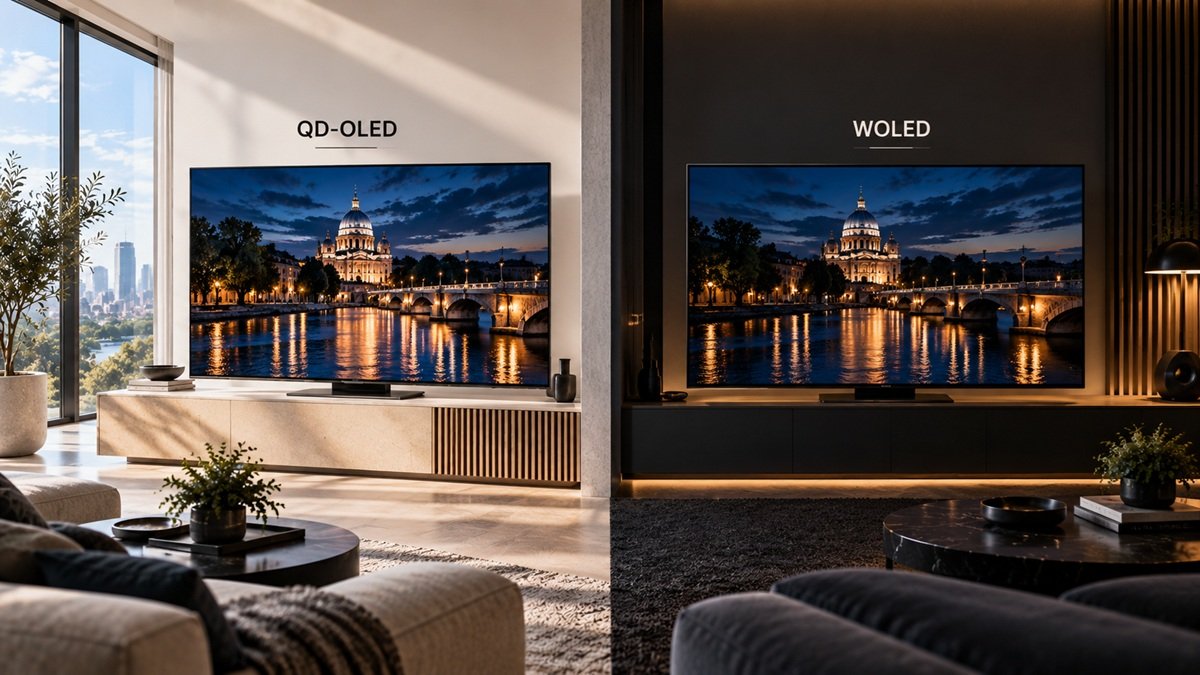
QD-OLED vs WOLED: Which OLED Type Fits Your Room?
Last updated: September 2026
🕒 7 min read
Disclosure: This article does not contain affiliate or sponsored links. SignalVetted may still reference specific products or brands for informational purposes only.
You have decided on an OLED, and now the shelf offers two kinds. In a completely dark room, RTINGS found no difference in black levels between them, so the choice comes down to something else. This page turns RTINGS’ QD-OLED vs WOLED comparison into a decision: which type fits your room lighting and what you watch. For the wider picture of OLED TVs, our full OLED TV guide covers that separately.
Table of Contents
QD-OLED vs WOLED: The Short Answer Depends on Your Room and Your TV
RTINGS says QD-OLED “seems to be on a path to being declared the winner,” but with noticeable downsides, and that the best type overall depends on the individual TV. That is RTINGS’ verdict; this page is a synthesis of it, not our own lab testing. In its tests QD-OLED wins on colors, WOLED wins on black levels with room lights on, and the two tie in a dark room.
Our verdict, based on RTINGS’ comparison
Overall winner: none. RTINGS: the best one “depends on the individual TV.”
By condition: completely dark room, a tie. Lights on or a bright room, WOLED keeps deeper blacks. Vibrant, saturated content, QD-OLED.
Exceptions: RTINGS says high-end WOLEDs with newer panels deliver significantly brighter highlights and better reflection handling, while for lower-end and mid-tier OLEDs QD-OLED seems slightly better.
What Separates Them, in Three Sentences
A WOLED produces white light and passes it through red, green, and blue filters, with an extra white subpixel to boost brightness. A QD-OLED starts with blue light and uses quantum dots to convert it to red and green, with no filters and no white subpixel. Both are OLEDs at heart. For the full construction detail, see our explainer on OLED panel types.
For the basics of the technology, start with our explainer on what OLED TV technology actually is.
The Test Behind These Numbers
RTINGS compared three 2025 TVs: the Samsung S95F (QD-OLED), the LG C5 (WOLED), and the LG G5 (a newer tandem WOLED). It says the G5 is not very representative of the whole market and that a WOLED bought in 2025 is more likely to perform like the C5. So the numbers here compare the S95F with the C5, and these are RTINGS’ example models, not statements about either brand. The page dates from October 2025.
Which Type Fits Which Situation
| Your situation | Better fit, per RTINGS | Why |
|---|---|---|
| Watching in a completely dark room | Either (tie) | Perfect blacks on both |
| Room lights on, or a bright room | WOLED | Smaller black-level rise: C5 0.23 vs. S95F 2.44 cd/m² at 1,000 lx |
| Vibrant, saturated content | QD-OLED | HDR color volume: S95F 63.4% vs. C5 40.0% |
| Lower-end or mid-tier OLED | QD-OLED, slightly | RTINGS’ overall read |
| High-end WOLED with a newer panel | Depends on the TV | Brighter highlights, better reflection handling |
Blacks With Room Lights On: WOLED
This is the biggest practical difference RTINGS found. In a completely dark room the two are equal, with near-infinite contrast, and the coating makes almost no difference. With light in the room it changes. RTINGS measured the black luminance at 1,000 lx at 2.44 cd/m² for the S95F against 0.23 cd/m² for the C5. It explains that QD-OLEDs lack a polarizer, an intentional choice by the panel maker to boost brightness, so QD-OLEDs have the worst black-level rise of any TV type outside a few 8K models. In practice, with room lights on, QD-OLEDs lose the deep, inky blacks OLEDs are known for, and the more lights on, the worse it gets.
Reflections are a separate question. RTINGS says how well a TV handles reflected light depends more on the screen coating than on the panel type. The S95F’s peak reflection intensity was 4.8% against 40.3% for the C5, so the S95F handled reflections better in that test, but RTINGS credits the coating, not the panel, for the difference.
Colors: QD-OLED
RTINGS calls color saturation one of the biggest differences and names QD-OLED the winner: it creates very pure light with no need for filters or a white subpixel, and RTINGS says it delivers the best color-space coverage of any display technology it had tested as of 2025. In RTINGS’ HDR color-volume test at 10,000 cd/m², the S95F scored 63.4% against 40.0% for the C5. WOLEDs rely on the white subpixel at high brightness, which dilutes saturated colors; the S95F has none, so it shows no washout.
RTINGS adds that when calibrated you will not notice much difference on run-of-the-mill SDR content or even most HDR content. The gap shows up in really bright, vibrant material such as nature documentaries, anime, or some video games.
Brightness: It Depends on the TV
RTINGS finds no clear winner. Its chart of overall brightness scores shows QD-OLEDs in a narrow range and brighter on average, while WOLEDs span a wide range, so peak brightness has more to do with the specific panel and how the maker tunes it. Real scenes are messier: in RTINGS’ three real-scene tests the C5 was slightly brighter than the S95F each time, for example 1,074 against 1,004 cd/m² in the hallway scene. RTINGS notes that processing matters as much as the panel, and that the newer tandem WOLED panels deliver significantly brighter highlights.
Uniformity: QD-OLED, by RTINGS’ Label
RTINGS names QD-OLED the uniformity winner. Its 50% gray screen measured a standard deviation of 0.592% for the S95F against 1.106% for the C5. RTINGS is careful to add that almost all OLEDs have fantastic uniformity regardless of type, and that it varies between individual units, so it is really the luck of the draw.
Burn-In: Both Burn In, QD-OLED Might Be More Resilient
After running dozens of OLED TVs through an accelerated longevity test for almost three years, RTINGS says any OLED will eventually burn in with enough static content. It notes big improvements from one generation to the next, and that the results do not represent the current market. QD-OLEDs might be slightly more resilient, but RTINGS calls that far from definitive. With proper viewing habits, it says, this should not be an issue for most people.
PC Use and Text Clarity: No Winner
If you plan to use a large OLED as a PC monitor, RTINGS says both types have issues: QD-OLEDs can show color fringing at sharp borders because of their triangular pixel layout, and WOLEDs can show fringing around text because their subpixel order is not what PCs expect. RTINGS tests text clarity on monitors, not TVs, so it has no hard data for these TVs.
Scenario-Based Guidance
If you mostly watch in a dark room, the blacks are equal, so color and the rest of the TV’s performance should decide. If your room has lights on or plenty of daylight, RTINGS says WOLED holds its blacks better, and its conclusion calls WOLED a clear winner for bright rooms, citing its reflection handling and the higher peak brightness of pure whites. Note that RTINGS’ own reflection result depends on the coating, so check the specific TV. If you love vivid, saturated content, QD-OLED has the edge. And if you are shopping at the higher end, RTINGS says the best WOLEDs are significantly brighter, so compare individual models rather than panel types.
Common Misconceptions or Mistakes
A common misconception is that QD-OLED has better blacks because of the quantum dots. In a completely dark room the two are equal, and with lights on RTINGS found the WOLED did better.
A second is that one type is always brighter. RTINGS says peak brightness depends on the specific panel and how it is tuned, and in its own real-scene tests the C5 was slightly brighter than the S95F.
A third is that the panel type settles the purchase. RTINGS says the overall performance of each TV is more important than the specific panel used.
Frequently Asked Questions
Is QD-OLED better than WOLED?
Not across the board. RTINGS says QD-OLED seems to be on a path to being declared the winner, but the best one overall depends on the individual TV. QD-OLED leads on color and uniformity, and WOLED on blacks with room lights on.
Which is better for a bright room?
RTINGS’ conclusion calls WOLED a clear winner for bright rooms, and its tests show a smaller rise in black levels with lights on. Reflection handling, though, depends on the screen coating, so check the specific model.
Which type is more likely to burn in?
RTINGS says both types eventually burn in with enough exposure to static content. QD-OLEDs might be slightly more resilient, but that is far from definitive.
Are these results true for every QD-OLED and WOLED TV?
No. They come from three 2025 TVs, and RTINGS says its newest WOLED is not representative of the market. Compare the specific models you are considering.
Whichever way you lean, the panel type is only part of the picture. Look at how the specific TV performs in your room.

Nridi
Editor, SignalVetted
SignalVetted has not independently tested these products.
✅ Based on RTINGS.com’s independent QD-OLED vs. WOLED comparison (Samsung S95F, LG C5 and LG G5).