LG vs Samsung vs Sony OLED: How the C6 Compares to Each Rival
Last updated: September 2026
🕒 8 min read
Disclosure: This article does not contain affiliate or sponsored links. SignalVetted may still reference specific products or brands for informational purposes only.
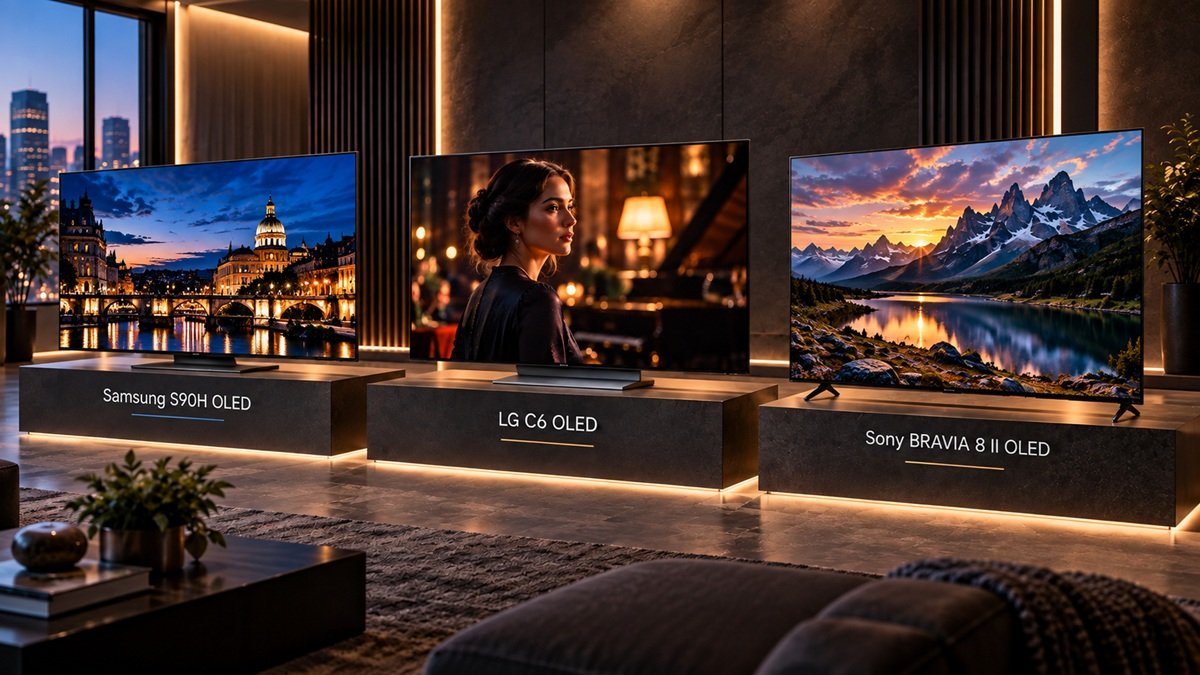
LG vs Samsung vs Sony OLED sounds like it should have one clean answer, but the honest version is two separate answers. RTINGS has directly and independently tested the LG C6 OLED 2026 against the Samsung S90H OLED, and separately against the Sony BRAVIA 8 II OLED. It has not tested the Samsung and Sony against each other. So this page reports both real comparisons RTINGS actually ran, keeps them distinct, and says plainly where the evidence runs out rather than guessing.
Treat this as two worked examples sharing one TV in common, not a three-way scoreboard. Every comparative claim below is RTINGS’ own stated finding, attributed to whichever specific comparison it came from.
Table of Contents
LG vs Samsung vs Sony OLED: The Short Answer
Against the Samsung S90H, RTINGS calls the LG C6 a bit better suited to home theater use — it’s brighter in HDR, supports Dolby Vision (which the S90H doesn’t), and has a processing edge. The S90H answers back with a matte coating RTINGS rates outstanding for cutting reflections, making it the better pick for a bright room.
Against the Sony BRAVIA 8 II, RTINGS calls the two TVs very similar overall, with the differences coming down to personal preference: the LG is a bit brighter, so small HDR details stand out slightly more; the Sony has much better reflection handling, so daytime glare is less distracting.
Our verdict, based on RTINGS’ two separate comparisons
Overall winner: none across all three. RTINGS ran two independent comparisons, not a three-way test, so there’s no single ranking to report.
By pairing: LG C6 vs Samsung S90H — LG for home theater brightness and Dolby Vision, Samsung for bright-room reflection handling. LG C6 vs Sony BRAVIA 8 II — very close, LG slightly brighter, Sony noticeably better against glare.
Samsung vs Sony: not answered here. RTINGS hasn’t tested the S90H against the BRAVIA 8 II directly, and we’re not filling that gap with a guess.
Scope: What This Comparison Covers
This page reports two independent RTINGS comparisons that happen to share the LG C6 OLED 2026 as a common reference point: LG C6 vs Samsung S90H, and LG C6 vs Sony BRAVIA 8 II OLED. It is not a round-robin test of all three TVs against each other. The LG-vs-Sony evidence is recent and matched on both sides — RTINGS tested both TVs under the same methodology (v2.2.1), with both records updated within minutes of each other on September 18, 2026.
The LG-vs-Samsung evidence comes from RTINGS’ Samsung S90H review (also the basis of our LG OLED vs Samsung OLED comparison). Nothing here should be read as a claim about other LG, Samsung, or Sony OLED tiers, sizes, or model years, or about how the Samsung S90H and Sony BRAVIA 8 II compare to each other.
LG C6 vs Samsung S90H
RTINGS’ comparison sentence states the LG C6 is brighter in HDR than the S90H and supports Dolby Vision, a format the S90H doesn’t support at all — RTINGS’ own spec grid for the S90H lists HDR10, HDR10+, and HLG only. RTINGS also credits the C6 with a processing edge, part of why it calls the C6 a bit better suited to home theater viewing. On the other side, RTINGS rates the S90H’s matte anti-reflective coating as outstanding at cutting down direct reflections and excellent at handling total reflected light, with no rainbow-smearing artifacts — the specific advantage RTINGS points to when it calls the S90H the better choice for a bright room.
We hold no separate RTINGS lab dataset for the C6 in this session; the HDR-brightness and processing claims above are RTINGS’ own comparison-sentence wording, not independently re-derived data.
LG C6 vs Sony BRAVIA 8 II OLED
Per RTINGS’ own comparison, these two are very similar overall, with the differences coming down to personal preference. Specifically: the LG gets a bit brighter, so small details in HDR content stand out a little better; the Sony has much better reflection handling, so glare is less distracting during the day. On specs, both TVs are 4K with Dolby Vision support and a glossy screen finish.
The LG C6 runs a WOLED panel with a 165Hz native refresh rate; the Sony BRAVIA 8 II runs a QD-OLED panel with a 120Hz native refresh rate. RTINGS gates its numeric test results for this pairing — brightness, contrast, color accuracy, input lag, and similar figures — behind a paid membership, so none of those numbers appear here.
What We Can’t Tell You: Samsung vs Sony
This page does not compare the Samsung S90H and the Sony BRAVIA 8 II against each other, because RTINGS hasn’t published a direct test of that specific pairing. We could estimate an answer by reasoning through how each one compares to the LG C6 separately, but that would be our own inference dressed up as a finding, not something RTINGS actually tested — so we’re not doing it. If you’re deciding specifically between the Samsung S90H and the Sony BRAVIA 8 II, that’s a real gap in the evidence right now, not something this page can responsibly answer.
Where This Comparison Stops
This page is scoped to three specific products — the LG C6 OLED 2026, the Samsung S90H OLED, and the Sony BRAVIA 8 II OLED — compared in the two pairings RTINGS has actually tested, not as a full three-way verdict. It doesn’t cover other LG, Samsung, or Sony OLED tiers, sizes, or model years, and it doesn’t cover the Sony’s numeric test results, which RTINGS gates behind membership. For the LG side specifically, our LG OLED65C6 review goes deeper on that exact model.
For the Samsung side, our Samsung 65S90H review does the same. No equivalent SignalVetted review of the Sony BRAVIA 8 II exists yet, so there’s no matching internal link on that side.
If budget matters more than any of these three, our guide to the best OLED TVs under $1000 covers lower-tier options.
Frequently Asked Questions
Which OLED is better, LG, Samsung, or Sony?
There’s no single answer here, because RTINGS has run two separate comparisons, not a three-way test. Against the Samsung S90H, the LG C6 is better suited to home theater use and the S90H is better in a bright room. Against the Sony BRAVIA 8 II, the two are very close, with the LG a bit brighter and the Sony better against glare. Samsung vs. Sony isn’t answered here — see below.
Does Samsung or Sony have better reflection handling?
We can tell you how each compares to the LG C6: Samsung’s S90H is rated outstanding against the LG per RTINGS, and Sony’s BRAVIA 8 II is rated much better than the LG per RTINGS. But Samsung and Sony haven’t been tested against each other, so this page can’t say which of the two is better directly.
Does this comparison apply to every LG, Samsung, or Sony OLED?
This comparison does not establish that. It reports RTINGS’ findings on three specific models — the LG C6 OLED 2026, the Samsung S90H, and the Sony BRAVIA 8 II — not their brands’ full lineups.

Nridi
Editor, SignalVetted
SignalVetted has not independently tested these TVs.
✅ Based on RTINGS’ Samsung S90H OLED review and RTINGS’ LG C6 vs Sony BRAVIA 8 II OLED comparison.