
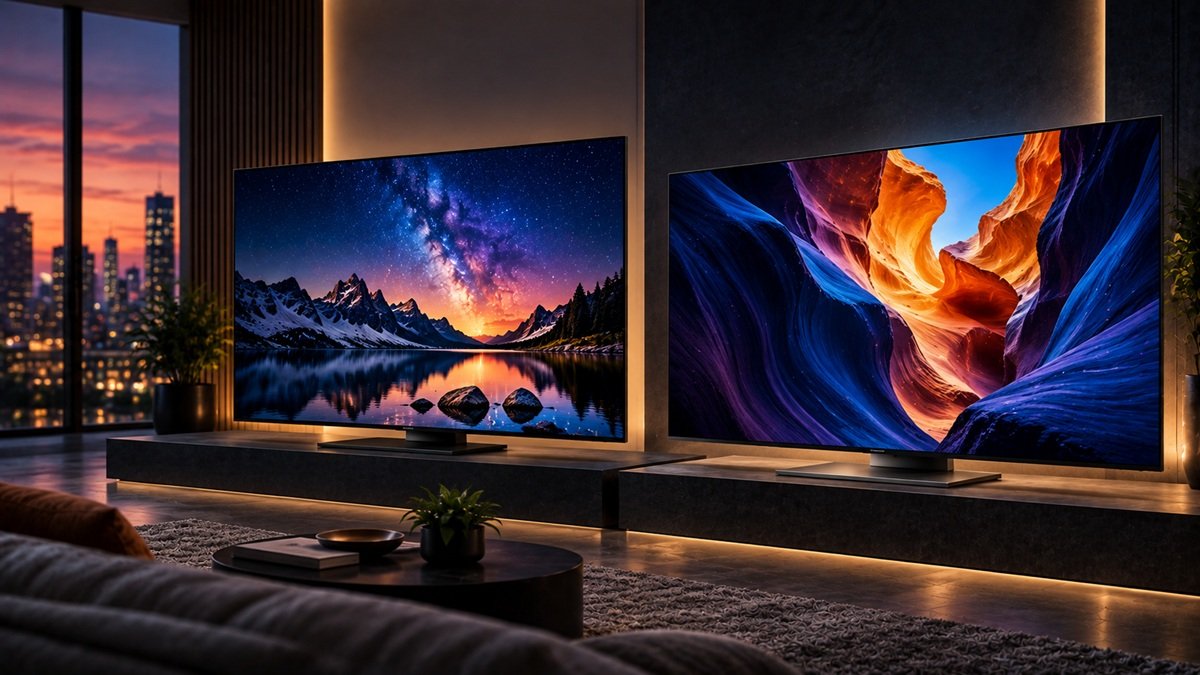
Best 65-Inch OLED TVs: LG vs. Samsung, Compared
Last updated: October 2026
🕒 12 min read
Disclosure: As an affiliate partner, we may earn a commission from qualifying purchases made through the links in this article, at no extra cost to you.
If you’ve settled on a 65-inch OLED, the real decision left isn’t “which one’s best” in the abstract — it’s LG or Samsung, and mid-flagship or budget tier, at the same screen size. Among the best 65-inch OLED TVs available right now, those two brands each split their 65-inch OLED lineup the same way: one model built around a newer processor and a higher refresh ceiling, and one built around a lower price. This guide walks through what actually changes between those four options, so you’re choosing based on what you’ll notice, not a spec sheet you have to decode yourself.
That’s a narrower decision than shopping OLED TVs in general, but it’s also a more useful one — once you’ve already committed to 65 inches and to OLED’s contrast and black levels over LCD/QLED alternatives, the remaining choice really is just these two variables, not a wide-open field of dozens of models. Get the tier question right and the brand question mostly comes down to preference, not performance.
Table of Contents
Quick Picks
| Category | Pick | Best For |
|---|---|---|
| Best Overall | LG OLED65C6 | Buyers who want LG’s newest processor and the highest refresh ceiling in this size |
| Best Overall Alternative | Samsung 65S90H | Buyers who want the mid-flagship tier but prefer Samsung’s ecosystem or its bright-room coating |
| Best Budget | LG OLED65B6GUA | Buyers who want LG’s picture quality without paying for the higher refresh ceiling |
| Best Budget Alternative | Samsung 65S85H | Buyers who want Samsung’s cheapest 65-inch OLED and don’t need the newer processor |
How to Decide: LG vs. Samsung, Mid-Flagship vs. Budget
Two questions actually decide this, not one. First: does a newer processor and a higher refresh ceiling matter to you, or would you rather pay less and not notice the difference in everyday viewing? Second: do you already have a brand preference, or a reason to lean LG or Samsung specifically — a soundbar or SmartThings/webOS setup you’re already in, for instance?
If refresh rate and processor generation matter — mainly a gaming consideration, since 165Hz vs. 120Hz and a newer upscaling chip show up most in fast motion and console gaming — the mid-flagship pick in your preferred brand (LG OLED65C6 or Samsung 65S90H) is the one to get. If you mainly watch movies and shows and don’t game competitively, the budget tier (LG OLED65B6GUA or Samsung 65S85H) gets you the same core OLED picture quality for less, and the processor gap matters far less in that use case.
Samsung’s own mid-flagship-vs-budget trade-off is close enough in practice that it’s worth reading side by side rather than taking our word for it — see our full Samsung 65S85H vs 65S90H comparison for the direct spec-by-spec breakdown.
There’s a third factor worth weighing alongside processor and price: the software and ecosystem each brand builds around its 65-inch OLED lineup. LG’s mid-flagship and budget models both run webOS, with the same smart-TV interface and app library across both tiers — so stepping down from the C6 to the B6GUA doesn’t cost you any software features, only the processor-driven picture and motion handling described above. Samsung’s approach is similar in structure but ties in more tightly with its own device ecosystem: Tizen OS, SmartThings integration, and, on the S90H specifically, the Glare Free anti-reflective coating that isn’t standard across Samsung’s whole 65-inch lineup.
Neither ecosystem is objectively better for most buyers, but if you already own other devices from one brand — a soundbar, a phone with matching casting features, other smart-home gear — that existing investment is a legitimate reason to lean that direction before comparing spec sheets line by line.
Best Overall: LG OLED65C6
The LG OLED65C6 earns Best Overall here because it pairs LG’s current Alpha 11 Gen3 processor with a 165Hz refresh ceiling — the highest combination in this batch of four, and the pick most likely to keep up with next year’s games and content without feeling dated. Based on the product’s own specification data, it supports Dolby Vision and AI-driven upscaling on top of the standard WOLED evo panel.
The honest trade-off: this is LG’s standard WOLED evo panel. RTINGS’ model table lists the 65-inch C6 with a WOLED panel, and lists Tandem OLED for the 48-inch C6 and the 77- and 83-inch C6H, so a buyer who specifically wants a Tandem OLED panel should look at those models instead.
For gaming specifically, the C6 supports VRR and ALLM alongside its 165Hz ceiling, so a current-generation console or PC gets low-latency, tear-free output without extra setup. Viewing angle is the one area where any WOLED panel — including this one — trails a true wide-viewing-angle panel design: off-axis color and contrast shift more than on a premium LCD with wide-angle treatment, though this is consistent across the whole 65-inch OLED category, not a C6-specific weakness. For a primary living-room set watched mostly head-on, that’s rarely a practical issue; it matters more if the TV serves a wide seating area at sharp angles.
🛒 Check LG OLED65C6 (paid link)
Best Overall Alternative: Samsung 65S90H
The Samsung 65S90H is the Samsung-side answer to the C6 — same mid-flagship positioning, its own Gen3 processor (NQ4 AI Gen3), and a matching 165Hz refresh ceiling, per Samsung’s own product page. It’s the pick for someone who wants the mid-flagship spec sheet but is already leaning Samsung, whether for the ecosystem or for the Glare Free coating Samsung includes at this tier.
One thing worth flagging honestly: this model’s panel is LG-Display WOLED rather than the Samsung-Display QD-OLED panel it was originally listed under — a correction, not the original spec, now independently confirmed by TechRadar’s own reporting on Samsung’s 2026 mid-range OLED lineup, not just this site’s internal records.
Beyond the panel-brand note above, the S90H’s practical strengths are its Glare Free coating — a real practical advantage in a bright room where reflections are the bigger picture-quality problem, more than raw brightness — and VRR/ALLM support matching the C6’s gaming feature set at the same 165Hz ceiling. Buyers weighing this against the C6 specifically, rather than against Samsung’s own budget tier, are mostly choosing between LG’s webOS and Samsung’s Tizen/SmartThings ecosystem once processor and refresh specs are held equal, since both mid-flagship models land in the same performance tier on paper.
🛒 Check Samsung 65S90H (paid link)
Best Budget: LG OLED65B6GUA
The LG OLED65B6GUA is LG’s entry-level 2026 tier at this size, per LG’s own product listing — the same core WOLED picture quality as the C6, built around LG’s Alpha 8 processor instead of the Alpha 11 Gen3, with a 120Hz refresh ceiling rather than 165Hz. For a buyer who mostly watches rather than games, that gap is easy to live with.
The honest trade-off is specifically for gaming-focused buyers: 120Hz is a real ceiling if you’re pairing this with a current-generation console or a gaming PC that can push higher frame rates — you won’t get the C6’s full refresh headroom on this model at any price.
The B6GUA still supports VRR and ALLM despite its lower 120Hz ceiling, so console gaming stays smooth and tear-free — the difference versus the C6 shows up in how high the frame rate can climb, not in whether these gaming features exist at all. For a household TV used across movies, live sports, and casual gaming rather than competitive play, the practical viewing experience sits close enough to the C6 that the processor and refresh-rate gap is easy to justify trading for the lower price.
🛒 Check LG OLED65B6GUA (paid link)
Best Budget Alternative: Samsung 65S85H
The Samsung 65S85H is Samsung’s cheapest 65-inch OLED in this lineup, per Samsung’s own product page — the budget counterpart to the S90H, running Samsung’s older NQ4 AI Gen2 processor and a 120Hz ceiling, the same shape of trade-off as the LG budget pick above.
The same panel-brand note applies here as the S90H above: this model’s panel corrects to LG-Display WOLED from an original QD-OLED/Samsung-Display listing — a correction independently confirmed by TechRadar’s reporting and FlatpanelsHD’s own S85H-specific coverage (“S85H replaces last year’s S85F… will predominantly use WOLED panels”), not just this batch’s own internal product data. Beyond that, the processor and refresh-rate gap versus the S90H is the real trade for the lower price, not a hidden downgrade.
Like the B6GUA above, the S85H keeps VRR and ALLM at its 120Hz ceiling, so it isn’t missing core gaming features — just the higher refresh headroom the S90H offers. For buyers already committed to Samsung’s ecosystem but prioritizing price over the newest processor, the S85H delivers the same fundamental OLED contrast and black-level performance as the S90H, with the software and smart-platform experience unchanged between Samsung’s two tiers.
🛒 Check Samsung 65S85H (paid link)
LG or Samsung, Mid-Flagship or Budget: The Real Trade-Offs
Within LG’s own lineup, the gap between the C6 and the B6GUA is entirely processor generation and refresh ceiling — same panel, same brand, same core picture quality. If you’re deciding between LG’s two 65-inch tiers specifically, our LG OLED65B6GUA vs OLED65C6 comparison lays out exactly where that $-per-feature line falls.
Samsung’s budget tier tells a slightly different story, since it’s also the cheapest 65-inch OLED Samsung sells at this size — not just “Samsung’s other option” but its actual floor for this screen size. If the S85H’s price point specifically is what’s pulling you toward Samsung, our full Samsung 65S85H review covers what that price gets you in more depth than a Quick Picks table can.
Neither within-brand comparison is a case of one tier being simply worse — both are the same core panel technology and picture quality, sold at two price points with the newer processor and higher refresh ceiling as the differentiator. That’s worth remembering if the lower price on the budget tier makes it look like a compromise: for a buyer who won’t push the refresh ceiling or notice processor-driven upscaling differences, the budget tier isn’t a lesser TV, it’s simply the same picture quality at a lower cost.
Who Should Buy What
Gaming-focused buyers, especially anyone pairing this with a current-generation console or a high-refresh gaming PC, should default to the mid-flagship tier in whichever brand they prefer — the processor and refresh-rate gap is the one difference in this lineup that shows up in daily use rather than a spec sheet. Our full LG OLED65C6 review covers what that looks like on the LG side in practice.
Budget-first buyers who mostly watch movies, shows, and everyday TV rather than competitive gaming get the same core OLED picture quality from either budget pick, for less money, with a processor gap that matters far less outside of gaming. Buyers already leaning Samsung specifically — ecosystem, other Samsung devices, or the Glare Free coating on the mid-flagship model — should read our full Samsung 65S90H review before deciding between Samsung’s own two tiers.
Buyers without a strong brand preference either way can use price and availability as the tiebreaker once tier is decided: within a tier, the gap between an LG and a Samsung pick is close enough in practice that neither consistently outperforms the other on picture quality, so whichever is priced better or in stock at the time of purchase is a reasonable, low-risk way to decide.
Final Recommendation
If you’re not sure which axis matters more to you, default to this: gaming and future-proofing push toward the mid-flagship tier (LG OLED65C6 or Samsung 65S90H); budget and everyday viewing push toward the entry tier (LG OLED65B6GUA or Samsung 65S85H). Brand preference is a legitimate tiebreaker once you’ve settled tier — neither brand’s tier structure meaningfully outperforms the other’s at the same price point in this batch. For the complete OLED lineup across every size and price tier, our full OLED TV guide covers the full picture.
Frequently Asked Questions
What are the best 65-inch OLED TVs right now?
Among 65-inch OLEDs, the four worth comparing directly are the LG OLED65C6 and Samsung 65S90H at the mid-flagship tier, and the LG OLED65B6GUA and Samsung 65S85H at the budget tier — the choice comes down to processor generation, refresh ceiling, and brand preference rather than a clear best-overall winner.
Is LG or Samsung better for a 65-inch OLED?
Neither brand has a clear edge at the same tier and price point in this lineup — both use the same panel type at this size, and the practical differences (refresh ceiling, processor generation, Samsung’s Glare Free coating on its mid-flagship model) come down to which specific features matter to your setup rather than one brand outperforming the other broadly.
Do I need the mid-flagship tier, or is the budget tier enough?
If you game on a current-generation console or a high-refresh gaming PC, the mid-flagship tier’s higher refresh ceiling and newer processor are worth the difference. If you mostly watch movies and shows, the budget tier delivers the same core OLED picture quality for less, and the processor gap is far less noticeable outside of gaming and fast motion.

Nridi
Editor, SignalVetted
SignalVetted has not independently tested these TVs.
✅ Based on spec analysis and the sources named on this page.