
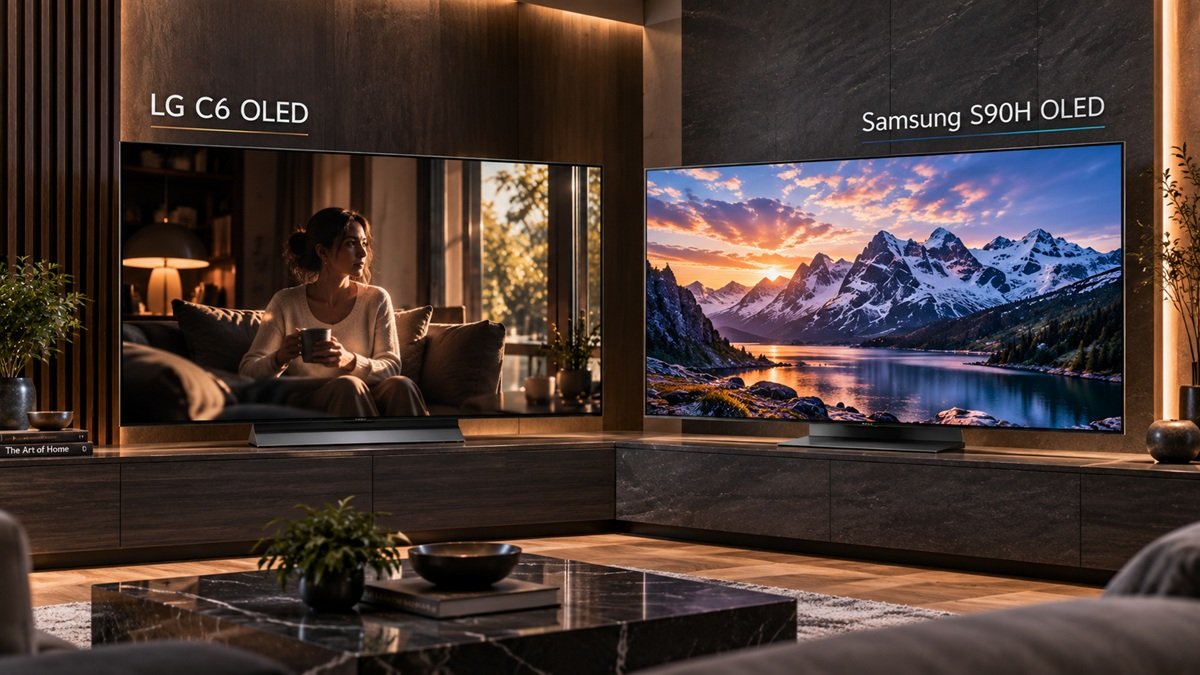
LG OLED vs Samsung OLED: How These OLEDs Compare in RTINGS Tests
Last updated: September 2026
🕒 7 min read
Disclosure: This article does not contain affiliate or sponsored links. SignalVetted may still reference specific products or brands for informational purposes only.
LG OLED vs Samsung OLED is a bigger question than any one pair of TVs can settle, so this page does something narrower and more honest: it reports how RTINGS’ own review of the Samsung S90H OLED compares that TV directly to the LG C6 OLED 2026. These are two specific, currently-tested models, not a scorecard for every LG or Samsung OLED ever made.
Think of this as a worked example rather than a lineup-wide verdict. RTINGS tested the Samsung S90H in full and wrote a direct comparison against the LG C6 as part of that review. We did not independently lab-test the C6 ourselves for this page; where a claim about the C6 goes beyond RTINGS’ own comparison sentence, it comes from LG’s official specifications instead, and we say so. See also our full OLED TV guide if you’re still deciding on size or budget before narrowing to a brand.
Table of Contents
LG OLED vs Samsung OLED: The Short Answer
RTINGS describes both TVs as excellent, each with its own strengths, rather than naming one an overall winner. Its gaming feature set is rated as comparable between the two. Where they diverge, according to RTINGS: the LG C6 is brighter in HDR, supports Dolby Vision, and has an edge in processing, which RTINGS says makes it a bit better suited to home theater use. The Samsung S90H’s matte coating gives it noticeably better reflection handling, which RTINGS says makes it the better pick for a bright room.
Our verdict, based on RTINGS’ comparison
Overall winner: none. RTINGS frames this as two strong TVs with different strengths, not a clear winner.
By category: LG C6 for HDR brightness, Dolby Vision, and processing; Samsung S90H for bright-room reflection handling; gaming features are rated comparable.
Conditions: dark or controlled-light room leaning home theater, the LG C6’s edge matters more. Bright room with real glare, the Samsung S90H’s matte coating is the more useful advantage, per RTINGS.
Scope: What This Comparison Covers
This page follows RTINGS’ own pairing: the Samsung S90H OLED (65-inch unit tested, results RTINGS says are also valid for the 55- and 83-inch sizes) against the LG C6 OLED 2026. RTINGS lab-tested the S90H in full; for the C6, this page relies on RTINGS’ own written comparison sentence plus LG’s official product specifications, not a separate RTINGS lab dataset for the C6 that we hold. Nothing here should be read as a claim about the 42-, 48-, or 77-inch Samsung S90H variants (RTINGS notes the 48- and 77-inch models use a different panel type), or about any other LG or Samsung OLED tier or size.
Picture Quality and HDR
Both TVs use a WOLED-based panel — the Samsung S90H’s own spec sheet on RTINGS lists it as OLED with a WOLED sub-type, not QD-OLED, and LG’s official page describes the C6’s panel the same way. RTINGS’ comparison sentence states the LG C6 is brighter in HDR than the S90H and supports Dolby Vision, a format the S90H does not support at all — RTINGS’ own spec grid for the S90H lists HDR10, HDR10+, and HLG only. RTINGS also credits the C6 with a processing edge, which is part of why it calls the C6 a bit better suited to home theater viewing.
We hold no separate RTINGS brightness numbers for the C6 in this session; the HDR-brightness and processing claims above are RTINGS’ own comparison-sentence wording, not independently re-derived data.
Bright Room and Reflection Handling
This is where RTINGS’ own testing of the S90H is most detailed. RTINGS rates the S90H’s matte anti-reflective coating as outstanding at cutting down direct reflections, and rates its handling of total reflected light as excellent, with no rainbow-smearing artifacts. RTINGS’ comparison sentence attributes the bright-room advantage specifically to this coating, calling the S90H the better choice for a bright room. We do not hold an equivalent RTINGS reflection test for the LG C6 in this session, so this section reports the Samsung side’s tested result plus RTINGS’ own comparative judgment — not a side-by-side reflection measurement for both TVs.
Black Level in a Bright Room
RTINGS reports that the S90H keeps its black levels well in a room with ambient light — there’s a minor rise, but blacks stay deep enough that they don’t look washed out. In the same review, RTINGS adds a direct comparison: blacks on the S90H aren’t quite as deep in a bright room as on a similar OLED with a glossy coating, naming the LG C6 specifically. That’s a single attributed sentence from RTINGS about these two models, not a broader claim about matte-versus-glossy OLEDs in general.
Gaming Features
RTINGS’ comparison sentence says the two TVs share the same gaming feature set, making both good options for gaming. On the Samsung side, RTINGS’ own testing of the S90H found very low input lag in Game Mode, along with support for FreeSync, G-SYNC, and HDMI Forum VRR — including Low Framerate Compensation, so tearing stays controlled even when frame rates drop. On the LG side, per LG’s official specifications and RTINGS’ own testing of the C6 (cited for gaming performance in our LG OLED65C6 review), the C6 offers a 165Hz refresh ceiling with VRR and ALLM support. Reaching that full ceiling on either TV depends on having a source and HDMI 2.1 cable capable of it.
Where This Comparison Stops
This page is scoped to the Samsung S90H and the LG C6 OLED 2026 as RTINGS tested and compared them. It does not establish anything about Samsung’s or LG’s cheaper or pricier tiers, other screen sizes beyond what RTINGS says is valid for the S90H, or any other model year. It also does not cover audio quality, smart-platform experience, or long-term reliability for either brand. For the Samsung side specifically, our Samsung 65S90H review goes deeper on that exact model.
For the LG side, our LG OLED65C6 review does the same.
RTINGS has also compared the same LG C6 against Sony’s BRAVIA 8 II; our LG vs Samsung vs Sony OLED comparison reports both pairings side by side.
If budget matters more than brand, our guide to the best OLED TVs under $1000 covers lower-tier options from both LG and Samsung.
Frequently Asked Questions
Which is better, LG OLED or Samsung OLED?
Per RTINGS’ comparison of the LG C6 and Samsung S90H, neither is a flat winner. The LG C6 is brighter in HDR, supports Dolby Vision, and has a processing edge suited to home theater use; the Samsung S90H’s matte coating makes it the better pick for a bright room. This answer is scoped to these two tested models.
Does Samsung or LG have better reflection handling?
Samsung, according to RTINGS’ testing of the S90H. Its matte coating is rated outstanding at reducing direct reflections and excellent at handling total reflected light — the specific advantage RTINGS points to when it calls the S90H the better choice for a bright room.
Does this comparison apply to every LG or Samsung OLED?
This comparison does not establish that. It reports RTINGS’ findings on two specific models — the LG C6 OLED 2026 and the Samsung S90H — and RTINGS’ own results for the S90H are stated as valid for specific sizes only.

Nridi
Editor, SignalVetted
SignalVetted has not independently tested these TVs.
✅ Based on RTINGS’ Samsung S90H OLED review (its own comparison against the LG C6 OLED 2026) and LG’s official product specifications.