
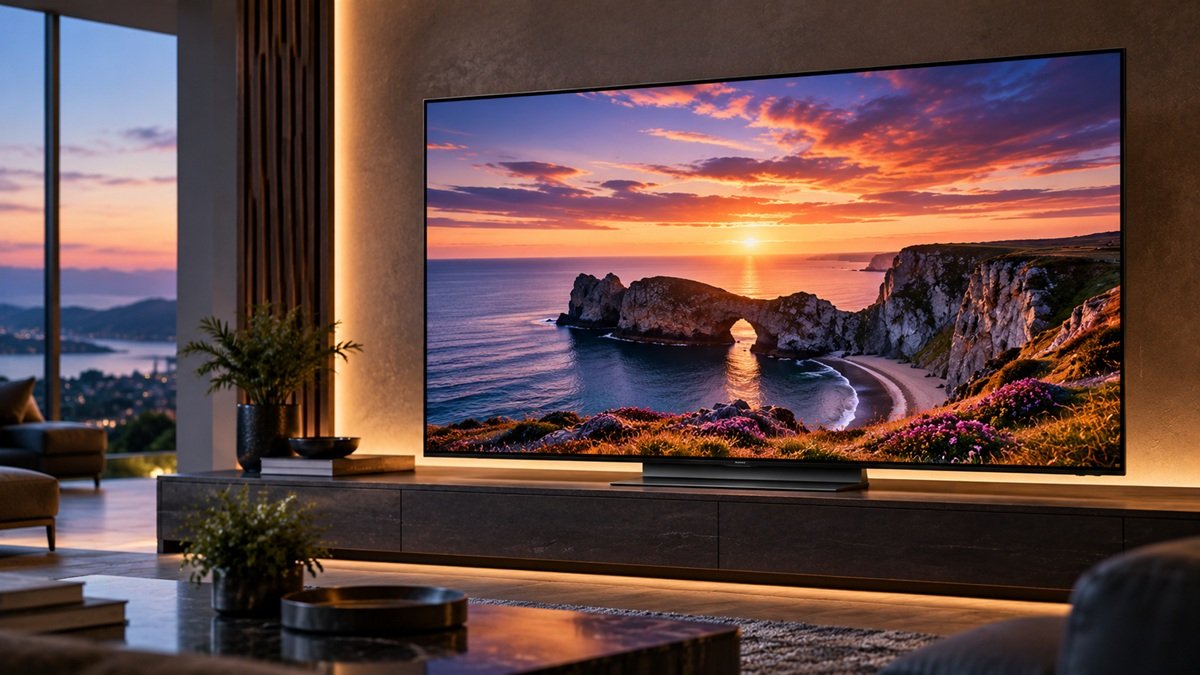
LG OLED65C6 Review: Is LG’s Mid-Flagship Worth the Step Up?
Last updated: October 2026
🕒 9 min read
Disclosure: As an affiliate partner, we may earn a commission from qualifying purchases made through the links in this article, at no extra cost to you.
Once you’ve decided on a 65-inch LG OLED, the harder question isn’t whether OLED is worth it — it’s whether LG’s mid-flagship tier is worth the jump over LG’s own cheaper option, or over Samsung’s competing tier at a similar price. The LG OLED65C6 sits right in the middle of that decision. Based on LG’s own published specifications, cross-referenced against this site’s sibling comparison of the C6 against LG’s entry-level OLED65B6GUA, the OLED65C6 pairs LG’s current Alpha 11 Gen3 processor with a 165Hz refresh ceiling — a real step up from the B6GUA, and a close match for Samsung’s mid-flagship 65S90H.
This LG OLED65C6 review walks through what that step-up actually buys you, how far apart LG’s own tiers really sit, and how the C6 stacks up against Samsung’s alternative — see our full OLED TV guide if you haven’t settled on 65 inches and OLED yet. If you already know you want LG’s newest 65-inch panel and processor combination, you’re in the right place; if you’re still weighing whether the jump is worth paying for, keep reading.
Table of Contents
Quick Verdict
At a Glance
👍 Best For: Buyers who want LG’s mid-flagship-tier panel and processor at 65 inches.
👎 Skip If: You’re on a strict budget, or you want a Tandem OLED panel — RTINGS’ model table lists one for the 48-inch C6 and the 77- and 83-inch C6H, but lists the 65-inch C6 with a WOLED panel.
One-Line Verdict: A genuine mid-flagship step up from LG’s entry tier, worth it mainly for buyers who’ll actually use the higher refresh ceiling.
🛒 Check Availability (paid link)
Product Specs at a Glance
Product Specs
LG OLED65C6
WOLED evo panel, Alpha 11 Gen3 processor, 65-inch, mid-flagship tier
| 📺 Panel Type | WOLED evo |
| ⚡ Processor | Alpha 11 Gen3, AI Super Upscaling |
| 🎮 Refresh Rate | 4K up to 165Hz |
🛒 Check Availability (paid link)
Ratings reflect editorial assessment only — not customer reviews on Amazon.
Design & Build Quality
Materials & Finish
LG hasn’t published teardown-level build details for the OLED65C6 the way it has for its top-shelf Wallpaper and Gallery lines, so what follows is based on LG’s published product data rather than hands-on inspection. The C6 uses LG’s standard evo-panel construction at 65 inches — a slim OLED panel on a rear chassis rather than the ultra-thin Gallery-style mount — which is the same physical format Samsung’s 65S90H competes with at this size. Neither brand offers a wall-flush design at this specific tier; that treatment is reserved for pricier flagship lines on both sides.
Ports & Connectivity
Setup follows LG’s current webOS platform, with HDMI 2.1 bandwidth needed to actually hit the 165Hz ceiling — worth confirming your source device and cable both support it, since a 165Hz-rated panel doesn’t guarantee 165Hz at the socket if either end of the connection can’t keep up. AI Super Upscaling runs at the processor level regardless of input source, so lower-resolution content gets the same upscaling treatment whether it’s coming from a streaming app or an external box. If you’re unsure whether webOS covers your streaming apps without an extra box, see whether you need a streaming device for an LG OLED.
Performance & Real-World Use
Everyday and Movie Viewing
For general viewing, the OLED65C6’s WOLED evo panel delivers the same fundamental contrast and black-level advantage every current OLED offers over LCD-based sets, with AI Super Upscaling doing the added work of cleaning up lower-resolution cable or streaming sources. Based on manufacturer specifications, Dolby Vision support is included, so HDR content mastered for it should render with the wider tone mapping the format is designed for. If you’re seeing stripes or steps in HDR scenes, our LG OLED HDR banding explainer covers what RTINGS’ testing found on the C6’s gradients.
Gaming
The 165Hz ceiling is the OLED65C6’s headline gaming spec, and it’s a genuine console-and-PC advantage over LG’s own entry tier. Per RTINGS’ own testing of the OLED65C6, VRR and ALLM support round out the gaming feature set, so a current-generation console gets automatic low-latency switching without manual menu digging. Whether the full 165Hz ceiling matters to you depends heavily on what you’re actually pairing it with — a console capped well below that frame rate won’t expose the difference the same way a high-end gaming PC would.
Upgrading From an Older or Non-OLED Set
For anyone coming from an aging LCD or an older-generation OLED, the jump is less about this specific model’s edge over its own siblings and more about OLED’s category-level contrast advantage — the kind of difference that shows up regardless of which 2026 OLED tier you land on. If that’s your starting point, the C6’s extra processor headroom over the B6GUA is a smaller factor in how big the upgrade feels than the OLED-versus-LCD jump itself. If running cost is part of the question, our guide to how many watts a TV uses lists the 65-inch C6’s reported on-mode power from its ENERGY STAR record.
Key Features Breakdown
Alpha 11 Gen3 Processor
This is the chip actually responsible for most of what separates the C6 from the B6GUA on paper — it handles the AI-driven upscaling, tone mapping, and motion processing that a panel alone can’t do. A newer processor generation shows up most in scenes with fast motion or lower-quality source material, where the upscaling engine has more work to do; on static, already-high-resolution content, the gap between processor generations narrows considerably.
165Hz Refresh Ceiling
Reaching 165Hz requires both a source capable of outputting it and an HDMI 2.1 connection able to carry it, so this spec’s real-world value is conditional rather than automatic. Gamers running a high-refresh PC setup get the most direct benefit; console gaming on current hardware typically caps well under 165Hz, which narrows — without eliminating — the practical gap against the B6GUA’s 120Hz ceiling for that specific use case.
The Good, the Bad, and the Ugly
Pros
- ✅ Alpha 11 Gen3 processor — LG’s current-generation chip, ahead of the entry-tier Alpha 8 used on the B6GUA.
- ✅ 165Hz refresh ceiling — the highest in LG’s 65-inch OLED lineup at this tier, useful for high-refresh gaming setups.
- ✅ Dolby Vision and AI Super Upscaling — both included standard, based on manufacturer specifications, without an added cost tier.
Cons
- ❌ No Tandem OLED panel — RTINGS’ model table lists Tandem OLED for the 48-inch C6 and the 77- and 83-inch C6H, but lists the 65-inch C6 with a WOLED panel.
- ❌ 165Hz only matters with the right setup — a source and cable both capable of the full refresh rate, which not every buyer already owns.
The Ugly
The honest trade-off buyers weighing the C6 against the B6GUA need to sit with: based on manufacturer specifications, both use the same underlying WOLED technology, so the C6’s premium is paying almost entirely for processor and refresh-rate headroom rather than a different picture-quality tier. If your actual viewing habits are movies and everyday TV rather than high-refresh gaming, that premium buys you less than the spec sheet alone suggests — the same processor-tier trade-off shows up on Samsung’s side of this lineup, between the 65S85H and 65S90H.
Who Should Buy This — and Who Shouldn’t
Buy This If
The OLED65C6 makes the most sense for buyers who’ve already decided they want LG’s mid-flagship tier at 65 inches and either game on a high-refresh setup or simply want the newest processor generation LG offers at this size. Think of it the way you’d think about upgrading a laptop’s chip rather than its screen: the panel technology is the same as the tier below it, but the processor is doing meaningfully more work. If you’re deciding specifically between LG’s two 65-inch tiers, our LG OLED65B6GUA vs OLED65C6 comparison lays out that trade-off in more depth than a single review can.
If your budget doesn’t stretch to the mid-flagship tier at all, our guide to OLED TVs under $1,000 covers the cheaper alternatives worth considering instead — the OLED65C6 itself isn’t a fit for that budget tier, so this is a link forward to other options once you’ve decided mid-flagship isn’t the right spend, not a claim that this model belongs on that list.
Skip This If
Strict-budget buyers are better served by LG’s own OLED65B6GUA or Samsung’s 65S85H, both of which deliver the same core OLED contrast without paying for the Alpha 11 Gen3 processor or the 165Hz ceiling. Buyers who specifically want a Tandem OLED panel should also look elsewhere: RTINGS’ model table lists the 65-inch C6 with a WOLED panel, and lists Tandem OLED for the 48-inch C6 and the 77- and 83-inch C6H. And if what you really want is a much bigger picture than a 65-inch panel, our OLED TV vs projector comparison weighs the C6 against a home-theater projector.
If a 77-inch Tandem OLED panel is what you are after, RTINGS’ model table lists one for the C6H at 77 and 83 inches, and our LG OLED77C6H review covers that model.
Final Verdict
Is the LG OLED65C6 Worth Buying?
For buyers who’ll actually use the 165Hz ceiling or want LG’s newest processor generation at 65 inches, the OLED65C6 delivers a real, usable step up over LG’s own entry tier — not just a higher number on a spec sheet. Buyers who mostly watch rather than game get a smaller practical benefit from that same jump, which is worth weighing honestly before paying the mid-flagship premium. Compared against Samsung’s 65S90H, the two land in the same performance tier on paper, so the decision between them often comes down to ecosystem and brand preference rather than a clear performance gap — see our Samsung 65S85H vs 65S90H comparison for how Samsung’s own tiers compare.
The S90H’s panel is now confirmed, per independent reporting from TechRadar and FlatpanelsHD, to use an LG Display-sourced WOLED panel rather than Samsung’s own QD-OLED, a correction from the S90H’s original listing worth knowing before you compare the two side by side.
🛒 Check Availability (paid link)
Frequently Asked Questions
Is the LG OLED65C6 a good TV for gaming?
Per LG’s own specifications and RTINGS’ own testing of the OLED65C6, the 165Hz refresh ceiling, VRR, and ALLM support make it a strong gaming option at this size — provided your console or PC and HDMI 2.1 cable can actually reach that refresh rate. Without that setup, the practical gaming benefit over LG’s 120Hz entry tier narrows.
How does the LG OLED65C6 compare to the Samsung 65S90H?
Both land in the same mid-flagship tier on paper — matching processor generation and the same 165Hz ceiling — so the choice mostly comes down to ecosystem preference and Samsung’s Glare Free coating rather than a clear performance winner. Based on manufacturer specifications, both use a WOLED panel — including the S90H, whose panel is LG Display-sourced rather than Samsung’s own QD-OLED, a switch independently confirmed by TechRadar and FlatpanelsHD.
Is the OLED65C6 worth it for everyday TV and movie watching?
If you’re not gaming at a high refresh rate, the practical difference against LG’s cheaper OLED65B6GUA is smaller than the spec sheet suggests, since both use the same underlying panel technology. The C6 is easiest to justify when you’ll actually use its processor and refresh-rate advantages.
Who should skip the LG OLED65C6?
Strict-budget buyers and anyone who won’t use a high refresh rate are better served by the LG OLED65B6GUA or Samsung 65S85H, which deliver the same core OLED picture quality for less. Buyers who specifically want a Tandem OLED panel should also look elsewhere, since RTINGS’ model table lists the 65-inch C6 with a WOLED panel. For the 48-inch C6, which RTINGS’ model table lists as Tandem OLED, see our LG OLED48C6PUA review.
Does the LG OLED65C6 support Dolby Vision?
Yes — based on manufacturer specifications, Dolby Vision is included standard alongside AI Super Upscaling, with no separate purchase or subscription needed to access either.

Nridi
Editor, SignalVetted
SignalVetted has not independently tested this TV.
✅ Based on spec analysis and LG’s official product data.