
Glossy vs Matte TV Screen
Last updated: October 2026
🕒 5 min read
Disclosure: This article does not contain affiliate or sponsored links. SignalVetted may still reference specific products or brands for informational purposes only.
A common assumption is that matte screens handle reflections better than glossy ones. According to RTINGS’s page (Updated Mar 26, 2025), the glossy vs matte TV screen picture is less clear-cut. The top-performing glossy TVs came close to a matte TV on reflection intensity, while matte TVs lifted black levels more.
This guide follows RTINGS’s research on reflection handling. We did not run any tests ourselves. It covers how each finish handles reflections, what RTINGS means by black level raise, and where WOLED panels differ. It does not recommend a TV or cover cleaning; for cleaning, see our guide on how to clean a TV screen.
Table of Contents
Glossy vs Matte TV Screen: How Each Handles Reflections
Matte Screens
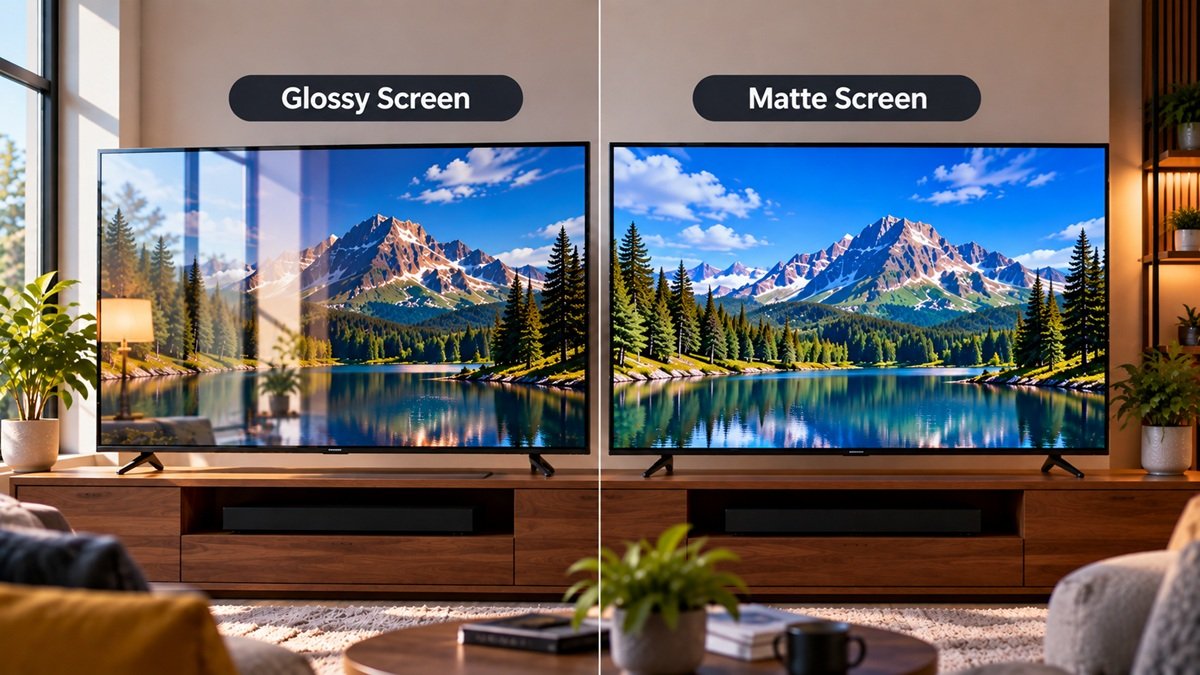
RTINGS says matte screens diffuse reflections over a larger area, which reduces their intensity. It adds that matte screens are known for good reflection handling, notably for reducing glare compared with glossy screens.
Glossy Screens
Glossy screens create strong, mirror-like reflections, according to RTINGS, instead of spreading the light over a larger area.
RTINGS says it expected clear-cut results between the two finishes. The more TVs it tested, though, the more it noticed an interesting trend: finish is only one piece of the reflections puzzle.
How RTINGS Tested Reflections
RTINGS’s page (Updated Mar 26, 2025) describes a reflections test suite it redeveloped. It has four parts: direct reflections, measured with a ring light and a camera; total reflected light; ambient black level raise; and ambient color saturation. You can read the full write-up in RTINGS’s reflection-handling research.
RTINGS calculates total reflected light as the area under the direct-reflection curve, so it counts all the light reflected off the screen: direct, indirect and haze. It does not give a peak reflection value or a black level figure. RTINGS therefore says total reflected light should be read together with its direct-reflection and ambient black level raise tests, and that a great total score doesn’t necessarily mean a TV is a top performer for the distracting glare from direct reflections.
Where Glossy and Matte Come Out Close
As RTINGS reports it, the difference in peak reflection intensity between the worst-performing matte TV and the top-performing glossy TV among the top six tested so far was 1.6%. The top-performing glossy TVs performed very similarly to a matte model in the intensity of light reflected off the screen, RTINGS says, which means they reduced glare nearly as effectively.
Not every glossy TV does that well, though: RTINGS says glossy TVs’ direct-reflection results varied widely in its new test.
Where Matte Costs You: Black Level Raise
Matte screens manage direct reflections by spreading light across a wide area, RTINGS says. That diffusion raises black levels across a significant part of the screen, which reduces perceived contrast and the richness of dark colors. RTINGS calls this black level raise, and says both ambient light and haze, the scatter of light from the screen’s surface, cause it.
As of RTINGS’s page (Updated Mar 26, 2025), black level raise affected every matte TV it had tested to a larger extent than any glossy model in its lab.
In general, RTINGS describes an inverse relationship between direct reflection handling and black level raise. The more mirror-like a TV’s reflection, the less the TV diffuses light, and the less its black levels raise. Each finish therefore involves a trade-off.
The WOLED Exception
TVs with WOLED panels are an exception to that inverse relationship, according to RTINGS. By design, they have a circular polarizer, which RTINGS says is necessary because WOLED panels are bottom-emissive and built on a metal plate. The polarizer stops light from reflecting back toward the viewer off the metal backplate, so these TVs don’t raise their black levels or compromise their direct-reflection handling, RTINGS says.
RTINGS also names a downside. The polarizer reduces brightness by about 50%, which the TV’s self-emissive OLED layer has to make up. Beyond production costs, RTINGS calls that brightness loss the major technical drawback. Even with a polarizer, it says the screen finish and other hardware still play a significant role in how a TV manages direct reflections.
RTINGS says some WOLEDs also include a micro-lens array layer to boost brightness. This layer appears to scatter incoming light slightly, and RTINGS says that negatively affects black level raise compared with WOLEDs that don’t have it.
Reflections and Color in Bright Light
Black level raise affects more than black levels, RTINGS says. It also changes how viewers perceive colors, especially low-luminance colors such as dark shades.
As RTINGS describes it, its ambient color saturation test sets TVs to their maximum brightness in RTINGS’s recommended picture settings, then adds ambient light at 0, 1000 and 3000 lux. It scores the results at 1000 lux, which RTINGS describes as its approximation of a bright daytime environment. RTINGS found that TVs that are worse at limiting black level raise extend that problem to their low-luminance colors.
What RTINGS’s Research Does Not Settle
RTINGS is open about the limits of its tests. It calls the ambient color saturation test its first step in evaluating reflections as a whole, and says the impact of brightness and effective contrast is still to be explored. A TV can do well on direct reflections and black level raise and still fall short in a very bright room if it is too dim, which RTINGS says was a common issue on first-generation OLEDs.
In the same research, RTINGS says it was already planning a review and rework of its brightness testing, and that its new reflection test suite is just scratching the surface of what is needed to make comprehensive buying recommendations for bright-room TVs.
RTINGS updated its page on Mar 26, 2025. Its results are tied to that date, and we don’t apply them to 2026 TVs.
Frequently Asked Questions
Glossy vs Matte TV Screen: Which Is Better?
RTINGS doesn’t pick one. Its tests show a trade-off: matte screens diffuse reflections but raise black levels more, while glossy screens reflect more like a mirror and raise black levels less. Among the top six TVs it had tested for direct reflections so far, the gap in peak reflection intensity between the worst-performing matte TV and the top-performing glossy TV was 1.6%.
Do matte screens reduce glare?
According to RTINGS, matte screens diffuse reflections over a larger area, which reduces their intensity. The cost, it says, is black level raise: every matte TV it tested raised black levels more than any glossy model it tested.
Do WOLED TVs follow the same trade-off?
RTINGS says they are the exception. Their circular polarizer means they don’t raise black levels or compromise direct-reflection handling, though it reduces brightness by about 50%. RTINGS says a micro-lens layer on some WOLEDs appears to worsen black level raise.

Nridi
Editor, SignalVetted
This article does not report independent product testing.
✅ Based on RTINGS’s reflection-handling research (page updated Mar 26, 2025).