
OLED vs LED TVs: Which Wins in Each Category?
Last updated: September 2026
🕒 8 min read
Disclosure: This article does not contain affiliate or sponsored links. SignalVetted may still reference specific products or brands for informational purposes only.
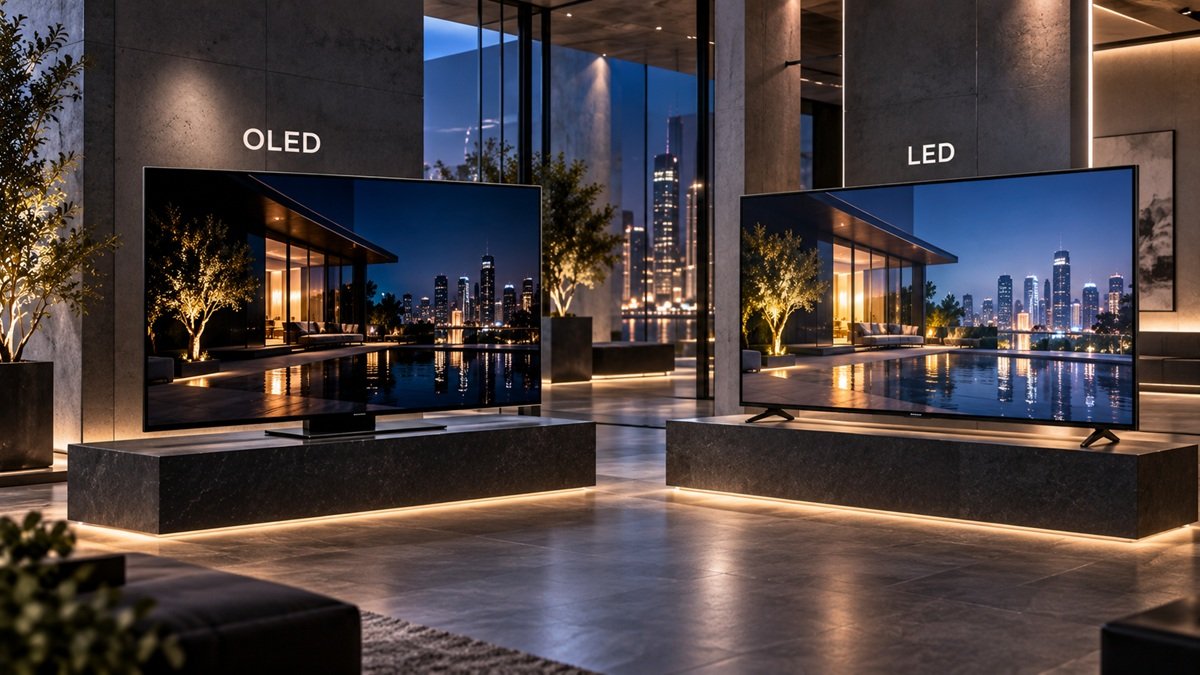
Two TVs, the same screen size, and two very different labels on the shelf. One says OLED, the other says LED, and the price gap can be large. Most advice online either declares that OLED is simply better or buries the question in a spec sheet. This page compares OLED vs LED TVs differently: a verdict for each category, with the caveat attached, based on RTINGS’ own head-to-head comparison. For how OLED TVs perform overall, our full OLED TV guide covers that separately from this specific matchup.
Table of Contents
OLED vs LED TVs: OLED Wins Most Categories, With Three Real Exceptions
RTINGS’ conclusion is that OLED is the far better technology, and its category results back that up: OLED came out ahead on contrast, colors, uniformity, and gaming response time, and ahead on brightness in most situations. That is RTINGS’ verdict, and this page is a synthesis of it rather than our own lab testing. It is also a qualified verdict. There are three situations where the LED set holds up or wins: budget and secondary-room use, large bright scenes such as sports, and movies or other low-frame-rate content.
Our verdict, based on RTINGS’ comparison
Overall winner: OLED, on picture quality.
Why: RTINGS names OLED the winner on contrast, colors and uniformity, on brightness in most cases, and on gaming response time.
Exceptions: a low budget or a secondary room, large bright scenes such as sports, and movie or TV content where slower LED response reads as smoother motion.
One note on scope before the details. RTINGS’ comparison covers LED TVs without quantum dots, and it explicitly leaves out QLED and QD-OLED models. We follow the same scope here: in this article, “LED” means an LED-backlit LCD TV without quantum dots. Quantum-dot sets are covered in our separate OLED vs. QLED comparison, so this article makes no claims about them.
Mini LED sets have their own page, OLED vs. Mini LED TVs, and the same scope note applies.
What Each Panel Actually Is
An OLED TV lights each pixel individually, so a pixel can switch fully off. An LED TV, in the sense used here, is an LCD panel lit from behind by LED backlights. The LCD layer filters that light; it does not produce its own. If you want the fuller explanation, our explainer on what OLED TV technology actually is walks through it. For this comparison, that one difference explains most of the results below.
For the LED side of that description, see our explainer on what an LED LCD TV is.
The Test Behind These Numbers
Every figure in this article comes from a single RTINGS pairing: the LG G5, an OLED from 2025, against the LG UT75, an LED model from 2024. These are RTINGS’ example models, not a statement about LG or about any brand. They are also two TVs, not category averages, so treat the numbers as an illustration of the technology gap rather than a rule for every set. RTINGS itself says this “wasn’t a fair fight” on price, and that its brightness result is valid for cheaper LED models. We state the comparator each time we say “brighter” so the numbers are not read as universal.
Category by Category
| Category | Winner (per RTINGS) | LG G5 OLED vs. LG UT75 LED |
|---|---|---|
| Contrast and blacks | OLED | Inf:1 vs. 941:1 |
| Brightness | OLED, mostly | HDR hallway scene: 1,120 vs. 211 cd/m² |
| Color | OLED | BT.2020 coverage: 70.17% vs. 46.60% |
| Uniformity | OLED | 50% gray deviation: 1.424% vs. 4.295% |
| Response time | OLED for gaming; LED for movies | Average CAD at 60Hz: 66 vs. 390 |
| Longevity | Tie | Different weak points; see below |
Contrast and Blacks: OLED, No Contest
RTINGS calls contrast “no contest.” The LG G5 measured infinite contrast, since its pixels can switch fully off, against 941:1 for the LG UT75. RTINGS also notes that the UT75’s backlight is either fully on or fully off, with no local dimming, so it cannot darken one part of the picture while lighting another.
Brightness: OLED Was Brighter, With One Big Exception
In the HDR hallway scene, RTINGS measured 1,120 cd/m² on the LG G5 against 211 cd/m² on the LG UT75, so the OLED was brighter than this cheaper LED model. RTINGS adds that this result is valid for cheaper LED models, and it does not claim every LED set is dimmer. It also flags the exception: on large, bright scenes such as sports, OLEDs typically do worse, and most LCD TVs are brighter. If you watch a lot of sports, that is worth weighing against the contrast advantage.
Color and Uniformity: OLED Again
On color, the LG G5 covered 70.17% of the BT.2020 color space against 46.60% for the LG UT75. RTINGS notes that both TVs use a white light source passed through RGB filters, and says those filters make the process inefficient. On uniformity, the OLED’s 50% gray screen deviated by 1.424% against 4.295% for the LED, meaning a smaller spread in brightness across the screen. RTINGS is careful here: exact uniformity varies from unit to unit, though it says OLED is “almost always better.”
Response Time and Motion: Gaming vs. Movies
This is the split category. RTINGS measured an average CAD at 60Hz of 66 for the LG G5 against 390 for the LG UT75, and it rates OLED better for gaming. But faster is not automatically better for film. RTINGS explains that a very fast response holds each frame static on screen, which can make low-frame-rate movie and TV content look juddery, while a bit of blur helps there. So for a console player, OLED wins clearly. For a movie fan, the LED’s slower response is a mild point in its favor, not a flaw.
Longevity: A Tie, With Different Weak Points
RTINGS rates longevity a tie, drawing on its 100-TV longevity test. The risks differ. OLED’s is burn-in, mostly with static content such as news channels or PC monitor use. For LED, RTINGS says edge-lit TVs tend to break faster under prolonged use, and a backlight can develop dark spots. For the depth on the OLED side, see our look at whether OLED burn-in still matters in 2026. We do not repeat that here.
Cost and Selection: No Winner, but a Real Reason to Choose LED
RTINGS does not name a winner on cost. It says LED TVs are far cheaper and available in many sizes, and it says this “wasn’t a fair fight” on price. Its advice is that LED makes sense as a cheap option, for example in a bathroom or garage. We do not quote prices here, since they change and are not part of the comparison we are drawing on.
Scenario-Based Guidance
If you watch mostly at night or in a dim room, RTINGS calls contrast “no contest” in OLED’s favor. If you play games on a console or PC, OLED’s response-time result favors it as well. If you watch a lot of sports, the large-bright-scene exception applies, so check how the specific TV you are considering handles bright content before assuming OLED is the better fit. And if you are buying for a secondary room on a tight budget, RTINGS itself points to LED as the sensible cheap choice. For readers who want OLED’s strengths and weaknesses on their own terms, our OLED TV pros and cons breakdown lays them out in one list.
Common Misconceptions or Mistakes
A common misconception is that “LED” and “OLED” are two brands of the same thing. They are not: an OLED pixel makes its own light, while an LED TV lights an LCD panel from behind, which is the source of most differences above.
A second is that OLED is always brighter. RTINGS’ result is that the OLED was brighter than a cheaper LED model in its test, and that most LCD TVs beat OLEDs on large, bright scenes. The answer depends on what you compare and what you watch.
A third is assuming the panel type settles the purchase. RTINGS says to look at the full picture. For us, that means weighing your room, your content, and your budget alongside the panel type.
Frequently Asked Questions
Is OLED better than LED?
In RTINGS’ comparison, yes, on most picture-quality categories: contrast, colors, uniformity, and gaming response time, and brightness in most situations. RTINGS calls OLED the far better technology, while also noting that LED is far cheaper and can be brighter on large, bright scenes.
Is a cheaper LED TV ever the smarter buy?
Yes, in specific cases. RTINGS recommends LED as a cheap option for rooms like a bathroom or garage, and the price gap is a real factor for a secondary TV that does not need the best picture.
Does OLED or LED last longer?
RTINGS rates longevity a tie based on its 100-TV longevity test. OLED’s weak point is burn-in with static content, while edge-lit LED TVs tend to break faster under prolonged use, and their backlights can develop dark spots.
Are these results true for every OLED and LED TV?
No. They come from one pairing, the LG G5 against the LG UT75, and RTINGS’ own scope excludes quantum-dot models. Read them as an illustration of the technology gap, not a guarantee for every set.
If you are still deciding whether the OLED premium is worth it for your own room and habits, our full look at whether OLED is worth it in 2026 is the natural next step.

Nridi
Editor, SignalVetted
SignalVetted has not independently tested these products.
✅ Based on RTINGS.com’s independent OLED vs. LED comparison (LG G5 vs. LG UT75).