Does TCL Mini-LED Look As Good As OLED? Here’s Where It Wins and Where It Still Doesn’t
Last updated: September 2026
🕒 9 min read
Disclosure: This article does not contain affiliate or sponsored links. SignalVetted may still reference specific products or brands for informational purposes only.
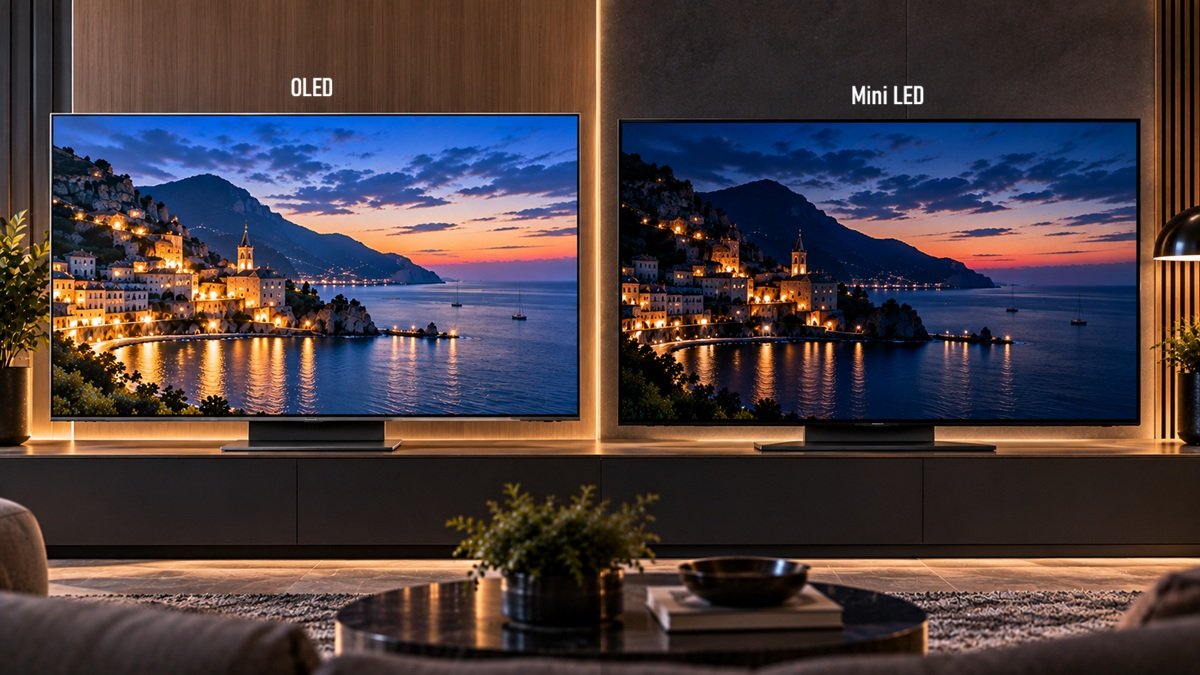
If you’re weighing a TCL Mini-LED against an OLED, the real question is whether the picture-quality gap has actually closed. RTINGS has actually tested a TCL Mini-LED TV in detail, and separately, RTINGS has run its own general comparison between Mini-LED and OLED technology. Neither of those is a direct TCL-versus-OLED lab test — the two RTINGS pages reviewed here don’t include one — but read together, they give a real, evidence-based answer instead of a marketing headline. For the fuller picture of how OLED TVs perform overall, our full OLED TV guide covers that separately from this specific comparison.
Table of Contents
So Does TCL Mini-LED Look As Good As OLED? It Depends Which Category You Care About
Two separate pieces of RTINGS testing matter here, and it’s worth keeping them apart. The first is RTINGS’ own review of the TCL QM8K, a Mini-LED model, which describes its dark-room performance in strongly positive qualitative terms. The second is a completely separate RTINGS article comparing Mini-LED against OLED in general, using flagship 2025 models from other brands — not TCL. In that general comparison, OLED wins almost every dark-room and motion-clarity category, and Mini-LED’s clearest win is peak brightness. The QM8K page adds one direct comparison to an OLED worth calling out on its own: film stutter.
How TCL’s Own Mini-LED Actually Tested
Contrast and Black Levels
Per RTINGS’ review of the TCL QM8K, “the contrast on this TV, especially with local dimming, is fantastic. The native contrast is also very high, ensuring blacks remain fairly deep even in more difficult scenes when the local dimming can’t keep up.” Zone precision is described as “excellent overall,” with only “a slight halo effect around subtitles or bright lights when viewed at an angle.” Black uniformity is called “nearly perfect.” RTINGS’ exact contrast-ratio number for this model sits behind its membership paywall, so this article isn’t citing a figure it can’t confirm — the qualitative language above is RTINGS’ own, not a paraphrase.
The RTINGS quote above names local dimming as one factor in that contrast. Our explainer on what local dimming is covers how that backlight feature improves contrast and why it can also cause blooming or haloing.
Brightness
The QM8K’s published brightness figures are strong: a peak 2% HDR window of 3,431 cd/m² and a peak 10% window of 3,605 cd/m², and a real-scene SDR peak of 753 cd/m² — RTINGS’ older results with TCL’s “Boost” setting disabled. RTINGS has since retested with Boost enabled, and those updated figures sit behind its membership paywall. RTINGS’ review summary calls it “bright enough to overcome glare in any room.”
Viewing Angle
Here’s where TCL’s own review is more mixed: RTINGS calls the QM8K’s viewing angle “mediocre,” noting brightness drops off “at a fairly narrow angle” and colors wash out “at a moderate angle.” TCL’s newer WHVA panel type is built to improve on this compared to older VA panels while keeping the same deep blacks, and RTINGS does note it performs better than TCL’s own prior-generation QM7K in this regard — but “better than TCL’s last panel” isn’t the same claim as “as good as OLED.”
How OLED Compares, Per RTINGS’ Own General Testing
Where OLED Wins
RTINGS’ separate Mini-LED vs. OLED comparison — again, using a Sony Mini-LED and LG/Samsung OLEDs, not TCL — names OLED the winner on contrast, lighting zone precision (“no contest here; OLEDs are simply better”), black uniformity, viewing angle, and gray uniformity. RTINGS explains that OLED pixels can be controlled individually, the design our explainer on what OLED TV technology actually is covers in more depth.
For a category-by-category breakdown of that comparison, see our OLED vs. Mini LED TVs comparison.
Response Time, Where the Gap Is Widest
The response-time numbers are stark: an average cumulative deviation of 348 for the Mini-LED tested versus 49 for the OLED at 120Hz. RTINGS notes that “all OLEDs, regardless of type, can transition nearly instantaneously from one shade to the next,” which it says matters most “when gaming at 120Hz or higher,” and that even the best Mini-LED on the market “falls far short of even the slowest OLED.” That speed comes up again in the film-judder result below.
Brightness and Longevity, Briefly
The same comparison found Mini-LED ahead on brightness — “even the dimmest Mini LED we’ve tested is brighter than the vast majority of OLEDs” — and called longevity a tie, since OLEDs risk burn-in on static content while Mini-LED backlights can fade or develop uniformity issues over years of use.
The One Counter-Intuitive Result: Film Judder
Here’s the part a simple “who wins” framing tends to miss. RTINGS’ general comparison shows OLED far ahead on response time. But RTINGS’ own QM8K review says the TCL “has visible stutter when watching 24p and 25p content, especially in slow panning shots,” and adds that it’s “not quite as bad as TVs with OLED panels, like the Samsung S90F OLED, but it’s still noticeable if you’re sensitive to it.” That is one direct RTINGS comparison inside the TCL review, not a matched test.
Our reading — an inference, not a statement from either RTINGS article — is that the near-instant pixel switching that helps fast gaming motion is also what leaves slow pans on an OLED more prone to stutter, while the TCL’s slower response is more forgiving on that one artifact. Same underlying difference, opposite verdict, depending on what’s on screen.
A separate feature worth knowing about is motion smoothing, which some TVs use to add interpolated frames to what you watch. Our explainer on what motion smoothing is covers how it works and why it can make movies look unnatural.
Scenario-Based Guidance
If you mainly watch in a dark or dim room and care most about deep blacks, precise local dimming, wide viewing angles, and fast-motion clarity for gaming, RTINGS’ general testing still points to OLED as the stronger overall choice on those specific fronts.
If you watch mostly in a bright room, want the highest peak brightness for HDR highlights, or care about long-term burn-in risk more than backlight fade, a well-reviewed Mini-LED like the QM8K is a reasonable trade rather than a downgrade — that’s a longer-term ownership question, and our look at whether OLED burn-in still matters in 2026 covers the OLED side of that trade-off in more depth.
Common Misconceptions or Mistakes
A common misconception is assuming RTINGS directly pitted the TCL QM8K against a specific OLED model in one matched test. Neither page reviewed here does that — the TCL-specific findings and the general Mini-LED-vs-OLED comparison are two separate pieces of testing, using different TVs, and this article has kept them apart rather than blending them into one head-to-head that doesn’t exist.
A second misconception is treating the QM8K as TCL’s current flagship Mini-LED. RTINGS’ own review page states plainly that “this TV was replaced by the TCL QM8L.” The findings above reflect TCL’s most recently fully reviewed model available to this article, not necessarily TCL’s latest generation.
A third misconception is generalizing “Mini-LED is closing the gap” from one favorably-worded review to Mini-LED TVs as a category. RTINGS’ own general comparison still shows a real, measured gap between Mini-LED and OLED on most dark-room metrics — one strong TCL review doesn’t erase that broader pattern, it just shows where one specific model lands within it.
Frequently Asked Questions
Does the TCL QM8K actually beat OLED at anything RTINGS tested?
RTINGS didn’t test them head-to-head, so there’s no matched result. Two separate RTINGS statements point in TCL’s favor: its general article found Mini-LED brighter than the vast majority of OLEDs, and its QM8K review says the TCL’s 24p/25p stutter is “not quite as bad” as on the Samsung S90F OLED, though still noticeable if you’re sensitive to it.
Is the TCL QM8K still the right model to compare against OLED?
It’s the model whose RTINGS review this article draws on, but RTINGS’ own page notes it has been replaced by the TCL QM8L, which RTINGS has since bought and tested. That page says the QM8L is substantially brighter with test slides and some very small HDR highlights, and about the same in most real content. Treat the figures here as representative of TCL’s recent approach, not necessarily its current-generation model.
If I mostly watch in a dark room, should I still consider a TCL Mini-LED over an OLED?
Based on RTINGS’ general Mini-LED-vs-OLED testing, OLED remains the stronger choice for dark-room categories like contrast, black uniformity, and viewing angle. TCL’s own reviewed model performs well in RTINGS’ qualitative descriptions of those same categories, but that isn’t the same as a confirmed win over a specific OLED in a matched test.

Nridi
Editor, SignalVetted
SignalVetted has not independently tested these products.
✅ Based on RTINGS.com’s independent TCL QM8K testing and its separate Mini-LED vs. OLED comparison.