
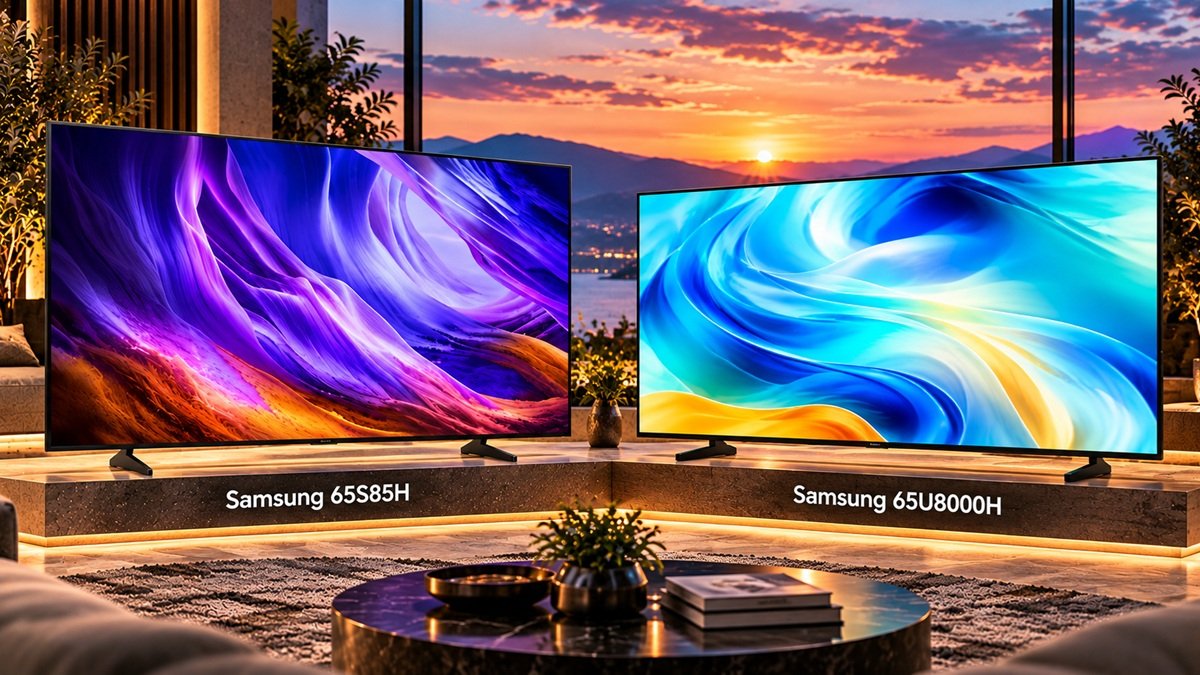
Samsung 65S85H vs Samsung 65U8000H: Two Glossy 65-Inch Samsungs, Compared Through RTINGS’ Results
Last updated: October 2026
🕒 6 min read
Disclosure: As an affiliate partner, we may earn a commission from qualifying purchases made through the links in this article, at no extra cost to you.
AI Disclosure: This article was produced with AI-assisted drafting and human editorial review. Claims are checked against the approved sources listed for this page’s claim type before publication.
The Samsung 65S85H vs Samsung 65U8000H pairing is an OLED against an LCD, yet both have a glossy screen. RTINGS tested each in its own review at 65 inches, and this page sets the two side by side with a focus on bright rooms, uniformity and upscaling. Inference: with the same finish on both, the panel and brightness rows decide the rest.
SignalVetted has not tested either TV. Neither RTINGS review compares the two models, so the table below is our own side-by-side of two separate reviews, and each column says which review it comes from.
Table of Contents
Quick Comparison: Samsung 65S85H vs Samsung 65U8000H (65-Inch)
| Samsung S85H (65S85H) | Samsung U8000H (65U8000H) | |
|---|---|---|
| Panel type | OLED (WOLED) | LCD (VA) |
| Native refresh rate | 120Hz | 60Hz |
| Screen finish | Glossy | Glossy |
| Contrast (RTINGS wording) | “Nearly infinite” | “Poor” |
| SDR brightness (RTINGS wording) | “Okay” | “Poor” |
| HDR brightness (RTINGS wording) | “Decent” | “Bad” |
| HDMI bandwidth | HDMI 2.1 on all four ports | HDMI 2.0 |
| Viewing angle (RTINGS wording) | “Great” | “Mediocre” |
| Black uniformity (RTINGS wording) | “Perfect” | “Good” |
| Gray uniformity (RTINGS wording) | “Decent” | “Mediocre” |
| Upscaling (RTINGS wording) | “Very good” | “Just okay” |
| Burn-in risk (RTINGS wording) | High with static elements | “Highly unlikely” |
| Processor | NQ4 AI Gen2 | Crystal Processor 4k |
| Dolby Vision | No | No |
| Smart interface | Tizen | Tizen |
Left column from RTINGS’ Samsung S85H review (reviewed Oct 07, 2026; test bench update Oct 27, 2026), right column from RTINGS’ Samsung U8000H review (reviewed Jul 31, 2026; writing modified Oct 23, 2026). Both 65-inch, both Methodology v2.3.1.
Scope: RTINGS tested the 65-inch size of each TV. This page covers the 65-inch only.
Two Glossy Screens in a Bright Room: 65S85H vs 65U8000H
In its Samsung S85H review, RTINGS says the glossy coating does very little against direct, mirror-like reflections, and that the TV looks okay in a bright room but struggles to overcome daytime glare.
RTINGS’ Samsung U8000H review lists the glossy finish among the TV’s cons: the coating does almost nothing to reduce the intensity of direct, mirror-like reflections. It rates SDR peak brightness as poor, not enough to overcome any significant glare during the day.
RTINGS also notes a global dimming feature (CE dimming) that darkens the whole screen in very dark scenes. For the full write-up on that TV, see our Samsung 65U8000H review.
RTINGS’ overall wording for both points to a moderately lit room, though its S85H finish section says the glossy coating makes that TV far less ideal for even a moderately lit room, a step down from the S90H’s matte coating.
The difference is in brightness: it calls the S85H’s SDR peak okay, with most content bright enough to overcome some glare in a moderately lit room, and the U8000H’s poor. Inference: the finish does not separate these two; brightness does.
Contrast and Dark Rooms
On the S85H, RTINGS reports a nearly infinite contrast ratio from self-lit pixels, with perfect black uniformity and no haloing around bright objects.
The U8000H has no local dimming, so RTINGS finds no haloing around bright elements or subtitles, but the entire image looks gray and washed out, and it rates contrast as poor. Inference: dark-room viewing is where the two reviews’ contrast wording differs most.
On burn-in, RTINGS reports a high risk of permanent burn-in on the S85H with static elements such as a breaking news sticker, though mixed content should not cause problems. For the U8000H it describes a relatively low risk of most panel issues as a direct-lit LCD, and calls permanent burn-in highly unlikely.
HDR Brightness
RTINGS rates the S85H’s HDR brightness as decent: very small highlights are not as bright as they could be but stand out because of the contrast, and brightness drops considerably when more of the screen is bright. For the U8000H, RTINGS’ HDR verdict is bad: bright scenes come across as flat and dull, and small highlights do not stand out.
Gaming, Viewing Angle and Smart Features
RTINGS gives the S85H a native refresh rate of 120Hz and the U8000H 60Hz.
On the S85H, RTINGS lists HDMI 2.1 on all four ports, FreeSync, HDMI Forum VRR and G-SYNC, and very low input lag in Game mode. The U8000H has HDMI 2.0 ports and, in RTINGS’ words, a few gaming features. Its input lag is just okay, low enough for casual games, though more experienced gamers might find it sluggish, and it reaches 120Hz only at 1080p.
Viewing angle is great on the S85H, where RTINGS says colors shift a bit toward the sides but barely noticeably across a wide seating area, and mediocre on the U8000H, where the image degrades rapidly toward the sides. Both run the 2026 version of Tizen, and RTINGS finds the U8000H’s interface a bit slow at times. Dolby Vision is absent on both.
Uniformity and Upscaling
RTINGS rates black uniformity as perfect on the S85H and good on the U8000H, where it notes some minor clouding. Gray uniformity is decent on the S85H and mediocre on the U8000H, with sides noticeably darker than the center in all content.
RTINGS says the S85H does a very good job upscaling low-resolution content such as DVDs. The U8000H’s upscaling is just okay: a bit soft overall, with fine details like text hard to make out.
The processors differ too, with Samsung’s NQ4 AI Gen2 in the S85H and its Crystal Processor 4k in the U8000H. RTINGS describes the U8000H itself as a very basic TV at the bottom of Samsung’s 2026 lineup, without quantum dots or local dimming.
Where the S85H Sits Against the S90H
RTINGS’ S85H review compares the S85H with the S90H. It says the two share the same dark-room performance, and that the S90H’s matte coating makes glare and mirror-like reflections less noticeable than on the S85H’s glossy screen. This page does not repeat that comparison for the U8000H.
Who Should Choose Which (Inference)
Who Should Choose the Samsung 65S85H
Inference: a buyer who wants dark-room contrast, uniform blacks and HDMI 2.1 on every port will find those results in RTINGS’ S85H review, which also reports a glossy screen that struggles in very bright rooms and a drop in brightness in large bright scenes.
Who Should Choose the Samsung 65U8000H
Inference: the U8000H review’s own use case is watching shows in a moderately lit room, so a buyer with that setup should weigh it against what the same review reports: a glossy screen that does almost nothing against direct reflections, poor SDR brightness, mediocre gray uniformity and just-okay upscaling.
Final Verdict
Inference: in the Samsung 65S85H vs Samsung 65U8000H comparison, both screens are glossy, so the finish does not separate them; the deciding rows are brightness, contrast and HDMI bandwidth, where RTINGS’ wording differs most (“okay” and “decent” against “poor” and “bad” brightness; “nearly infinite” against “poor” contrast; HDMI 2.1 against HDMI 2.0), plus the OLED-against-LCD panel difference.
Each review also lists its own caveats: for the S85H, the glossy screen’s weakness in very bright rooms and the brightness drop in large bright scenes; for the U8000H, a poor overall verdict. The S85H review also reports a high risk of permanent burn-in with static elements. Inference: how much those rows matter depends on your room and your devices. We do not pick for you.
🛒 Check Samsung 65S85H(paid link)
🛒 Check Samsung 65U8000H(paid link)
FAQ
What is the main difference in the Samsung 65S85H vs Samsung 65U8000H?
RTINGS reports a WOLED panel with a 120Hz native refresh rate for the S85H, and an LCD panel at 60Hz for the U8000H. Both have a glossy screen.
Is burn-in a concern on either TV?
On the S85H, RTINGS reports a high risk of permanent burn-in with static elements but no problems expected from mixed content. For the U8000H, RTINGS says burn-in is highly unlikely.
Which Samsung is better for gaming?
RTINGS lists HDMI 2.1 on all four S85H ports and HDMI 2.0 on the U8000H. Both support VRR, but RTINGS calls the U8000H’s not very effective. Inference: that is the gap to read first for console or PC gaming; the choice still depends on your setup.

Nridi
Editor, SignalVetted
SignalVetted has not independently tested these TVs.
✅ Based on spec analysis and the sources named on this page.