Samsung QN65LS03HE vs Samsung 65M70H: How the 65-Inch Frame and M70H Results Differ
Last updated: October 2026
🕒 5 min read
Disclosure: As an affiliate partner, we may earn a commission from qualifying purchases made through the links in this article, at no extra cost to you.
AI Disclosure: This article was produced with AI-assisted drafting and human editorial review. Claims are checked against the approved sources listed for this page’s claim type before publication.
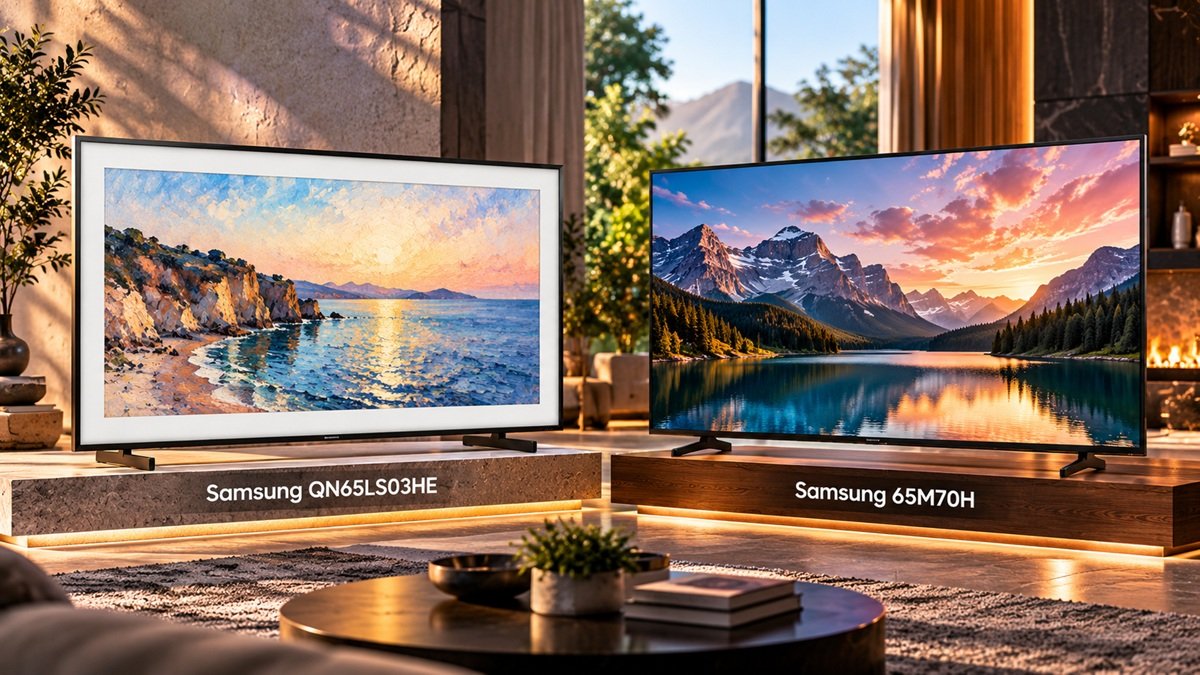
The Samsung QN65LS03HE vs Samsung 65M70H choice at 65 inches (The Frame 2026 against the M70H) shows up in RTINGS’ results on refresh rate, HDMI bandwidth, screen finish and brightness. RTINGS reviewed each at the 65-inch size in two separate reviews, and this page puts the two side by side. Inference: the weaknesses the two share matter as much as the differences.
SignalVetted has not tested either TV. Neither RTINGS review compares the two models, so the table below is our own side-by-side of two separate reviews, and each column says which review it comes from.
Table of Contents
Quick Comparison: Samsung QN65LS03HE vs Samsung 65M70H (65-Inch)
| The Frame 2026 (QN65LS03HE) | Samsung M70H (65M70H) | |
|---|---|---|
| Native refresh rate | 144Hz | 60Hz |
| Screen finish | Matte | Glossy |
| HDMI bandwidth | HDMI 2.1 on all four inputs | HDMI 2.0 on all three inputs |
| Backlight label in RTINGS’ review | Edge-lit | Direct-lit |
| Local dimming | RTINGS reports none | RTINGS reports none |
| Panel type | VA | VA |
| SDR brightness (RTINGS wording) | “Okay” | “Poor” |
| HDR brightness (RTINGS wording) | “Sub-par” | “Bad” |
| Contrast (RTINGS wording) | “Poor” | “Poor” |
| Dolby Vision | No | No |
| Smart interface | Tizen | Tizen |
Left column from RTINGS’ Samsung The Frame 2026 review, right column from RTINGS’ Samsung M70H review. Both 65-inch, both tested under Methodology v2.3.1.
Scope: RTINGS tested the 65-inch size of each TV. Its Frame review says the results are also valid for the 55-, 75-, 85- and 98-inch models. Its M70H size note covers the 43-, 55-, 75- and 85-inch models and does not list the 50-inch. This page covers the 65-inch only.
Refresh Rate and Gaming: QN65LS03HE vs 65M70H
Per RTINGS’ Samsung The Frame 2026 review, the Frame’s native refresh rate is 144Hz; per its Samsung M70H review, the M70H’s is 60Hz. RTINGS lists VRR support for both and rates input lag as excellent on the Frame and great on the M70H, adding that the M70H’s 60Hz limit means it is still not the most responsive-feeling TV.
For the Frame, RTINGS lists HDMI 2.1 bandwidth on all four inputs; for the M70H it lists three inputs, all HDMI 2.0, and says the VRR range is extremely narrow. Our Samsung QN65LS03HE review covers the Frame in full.
Inference: for a console or PC player, the refresh rate and the HDMI bandwidth are the two rows to read first. Our Samsung 65M70H review covers the M70H in full.
Screen Finish and Bright Rooms
RTINGS reports a matte anti-reflective coating on the Frame that removes most glare from direct reflections. It reports a glossy screen on the M70H that does barely anything against light from windows or lamps facing the TV.
On brightness, RTINGS calls the Frame’s SDR peak “okay” and the M70H’s “poor”, and lists among the M70H’s cons that it is not bright enough to overcome glare even in a moderately lit room. Inference: for a room with daylight or lamps facing the TV, the finish row and the brightness row point the same way in these two reviews.
Contrast and Picture: What Both Reviews Share
Both reviews give a “poor” contrast verdict. RTINGS says each panel has a very good native contrast ratio, but RTINGS reports no local dimming on either TV, so blacks are raised and the image looks gray or washed out.
The M70H is advertised as a Mini LED model; RTINGS says that label only means smaller LEDs in the backlight. RTINGS also rates the viewing angle as mediocre on both, and the gray uniformity as mediocre on the Frame and disappointing on the M70H.
Design and Smart Features
RTINGS describes the Frame as having a premium design, with replaceable bezels of equal thickness on all four sides and a built-in Art mode for artwork when you’re not watching TV.
Both run the 2026 version of Tizen; RTINGS reports up to seven years of system updates on the Frame and up to eight on the M70H, and finds the M70H’s interface noticeably slow.
Who Should Choose Which (Inference)
Who Should Choose the Samsung QN65LS03HE
Inference: a buyer who wants a matte screen, a 144Hz panel and HDMI 2.1 on every input will find those points in RTINGS’ Frame review. The same review reports poor contrast, no local dimming and a mediocre viewing angle.
Who Should Choose the Samsung 65M70H
Inference: a buyer who wants VRR support and low input lag will find both in RTINGS’ M70H review, which rates input lag as great. The same review reports a 60Hz limit, HDMI 2.0 on all three inputs, a narrow VRR range, poor SDR brightness and poor reflection handling.
Final Verdict
Inference: in the Samsung QN65LS03HE vs Samsung 65M70H comparison, the two reviews separate the sets on gaming hardware and finish (144Hz against 60Hz, HDMI 2.1 on all four inputs against HDMI 2.0 on all three, matte against glossy) and share poor contrast, no local dimming and a mediocre viewing angle.
Inference: whether the separating rows outweigh the shared weaknesses depends on your room and devices. We do not pick for you.
🛒 Check Samsung QN65LS03HE(paid link)
🛒 Check Samsung 65M70H(paid link)
FAQ
What is the main difference in the Samsung QN65LS03HE vs Samsung 65M70H?
RTINGS reports a 144Hz panel, a matte screen and HDMI 2.1 on all four inputs for the Frame, and a 60Hz panel, a glossy screen and HDMI 2.0 inputs for the M70H.
Do either of these TVs have local dimming?
RTINGS reports no local dimming on either TV (Frame review and M70H review), and gives a “poor” contrast verdict on both.
Which Samsung is better for gaming?
RTINGS lists VRR support for both. Inference: the Frame’s 144Hz panel and HDMI 2.1 inputs are the points that separate the two reviews for gaming; the choice still depends on your console or PC.

Nridi
Editor, SignalVetted
SignalVetted has not independently tested these TVs.
✅ Based on spec analysis and the sources named on this page.