Samsung 65QN70H vs Samsung 65QN80H: Gaming Features and Local Dimming, Per RTINGS
Last updated: October 2026
🕒 9 min read
Disclosure: As an affiliate partner, we may earn a commission from qualifying purchases made through the links in this article, at no extra cost to you.
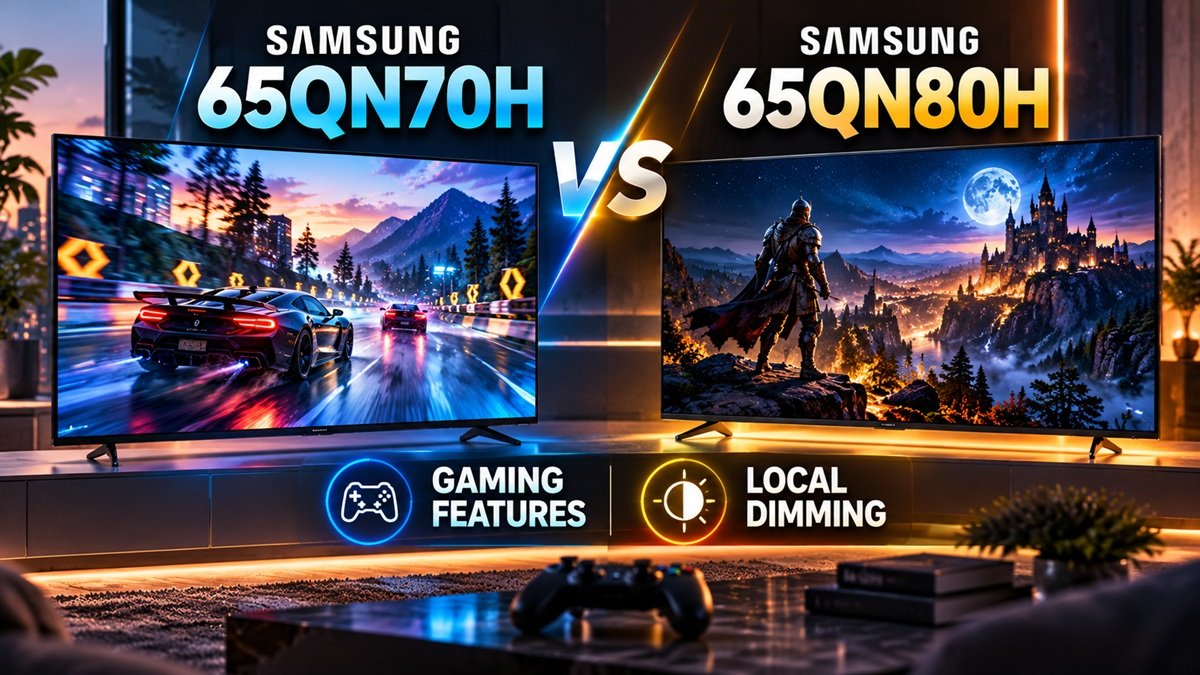
RTINGS tested the 65-inch Samsung QN70H and the 65-inch Samsung QN80H, and its results for the pair fall into two areas. In the Samsung 65QN70H vs Samsung 65QN80H comparison, the first area is gaming features: RTINGS lists a 60Hz native refresh rate, HDMI 2.0 and no VRR for the QN70H, against 144Hz, HDMI 2.1 and VRR for the QN80H. The second is local dimming, where RTINGS rates the QN70H’s zone precision as awful and its zone transitions as bad, and rates both as decent on the QN80H. This page compares those two areas and leaves the rest to RTINGS’ full reviews.
RTINGS calls the QN70H a lower mid-range, edge-lit TV powered by Samsung’s NQ4 AI Processor, and the QN80H a mid-range TV above it with the NQ4 AI Gen2 Processor. The QN70H review is dated August 28, 2026; the QN80H review, May 12, 2026. RTINGS also writes a direct comparison of the two, and that paragraph appears word for word on both review pages, so this page treats it as one source, not two.
SignalVetted did not test either TV. Everything below comes from RTINGS, and our own interpretation is labelled Inference. Inference: the gaming gap matters more than a refresh-rate number alone suggests, because the HDMI and VRR differences decide what a recent console or gaming PC can do.
Table of Contents
Quick Comparison
| Criterion | Samsung 65QN70H | Samsung 65QN80H |
|---|---|---|
| Native refresh rate | 60Hz | 144Hz |
| Dual Line Gate (1080p) | Up to 120Hz | Up to 240Hz |
| HDMI bandwidth | HDMI 2.0 on all ports | HDMI 2.1 on all four ports |
| VRR | Not supported | FreeSync, HDMI Forum VRR, G-SYNC Compatible |
| Zone precision | Awful | Decent |
| Zone transitions | Bad | Decent |
| Black uniformity | Mediocre | Great |
Built from RTINGS’ separate published results for each TV, set side by side; it is not a controlled head-to-head test.
Samsung 65QN70H vs Samsung 65QN80H: Gaming Features
Refresh Rate and Resolution
RTINGS lists the QN70H’s native refresh rate as 60Hz and says it supports 4K at 60Hz only. Samsung’s Dual Line Gate (DLG) feature boosts the refresh rate by lowering the resolution, and on the QN70H it allows 120Hz gaming at 1080p. RTINGS adds that 1080p at 120Hz can’t carry chroma 4:4:4, so PC text looks less clear. It says DLG is absent from the 43- and 50-inch QN70H models.
The QN80H is listed at 144Hz native and supports up to 4K at 144Hz. DLG is new for 2026, and on this TV RTINGS says it reaches 240Hz at 1080p. Chroma 4:4:4 signals display properly in every supported format, which RTINGS ties to clear text on a PC. Inference: a buyer who wants high refresh and also reads text from a PC would give up text clarity in the QN70H’s 120Hz mode, and would not face that choice on the QN80H.
HDMI Ports
On the QN70H, RTINGS reports HDMI 2.0 bandwidth at every port, which means recent consoles and gaming PCs can’t be used to full effect. On the QN80H all four of its ports carry HDMI 2.1 bandwidth. For the details of that extra bandwidth, see our HDMI 2.1 explainer.
Variable Refresh Rate
RTINGS reports no VRR support on the QN70H, so there is nothing to reduce screen tearing. The QN80H supports G-SYNC Compatible, FreeSync and HDMI Forum VRR, which RTINGS says works over its entire refresh range and includes Low Framerate Compensation. For background on the feature, see our page on what VRR does on a TV.
Console Compatibility and Input Lag
For the PS5 and the Xbox Series consoles, RTINGS calls the QN70H’s compatibility alright. It supports up to 4K at 60Hz or 1080p at 120Hz, so it can’t run 4K at 120Hz and can’t fully use either console. RTINGS says the QN80H handles the Xbox Series X|S at 4K and 120Hz and supports Auto Low Latency Mode.
RTINGS calls the QN70H’s input lag low, especially at 1080p and 120Hz, so gaming feels responsive, and it calls the QN80H’s excellent in every supported resolution and mode. Inference: RTINGS rates the QN80H’s input lag higher, and both are described as responsive; the larger difference is what each can be fed, since the QN70H tops out at 4K at 60Hz on HDMI 2.0 without VRR, while the QN80H lifts all three limits. Motion clarity is measured separately by RTINGS and is not compared on this page.
In its direct comparison, RTINGS says the QN80H offers many more gaming features and names 4K at 144Hz, 1080p at 240Hz and VRR. Because that paragraph is the same on both review pages, it is one RTINGS statement and not independent confirmation of the results above.
Local Dimming Quality: Zone Precision, Transitions and Uniformity
Zone Precision
RTINGS says neither TV lets you switch local dimming off. It rates the QN70H’s zone precision as awful, with haloing it calls very noticeable, both around bright lights in dark scenes and around subtitles. For the QN80H it says precision is decent: haloing shows around very bright areas, but subtitles are displayed well because light is averaged over many zones.
Inference: haloing appears on both TVs, so the difference is one of degree: RTINGS describes the QN70H’s as very noticeable around lights and subtitles, and the QN80H’s as noticeable around very bright areas, with subtitles handled well.
Zone Transitions
RTINGS rates the QN70H’s zone transitions as bad. Bright objects have visibly dim edges with haloing around them, which RTINGS says can be distracting. On the QN80H the transitions are decent overall, and RTINGS notes no visible flicker when bright highlights travel from zone to zone. Its processing lags a little behind fast-moving objects, though, so their leading edge looks darker than it should.
Black Uniformity
The QN70H’s black uniformity is rated mediocre. RTINGS describes patchy blacks, a cloudy look in entirely dark scenes, and local dimming that does little to improve uniformity. It adds that the QN70H’s local dimming does little to deepen blacks, leaving them raised and washed out in most scenes. The QN80H is rated great: RTINGS saw no noticeable flashlighting and evenly distributed black levels.
In its direct comparison, RTINGS says the QN80H’s local dimming is a big improvement over the QN70H’s, with much deeper blacks and far less haloing around highlights, and that this makes the QN80H look better in dark rooms.
Game Mode
RTINGS says local dimming performance doesn’t change when you switch the QN70H to Game Mode, and says the same for the QN80H. Since the QN80H is a bit brighter in that mode, though, haloing around bright objects becomes slightly more noticeable. Inference: for a gamer, the dimming results above are the ones that apply in-game, and the QN80H’s haloing, while noticeable, is rated decent where the QN70H’s is rated awful.
Backlight Design and Reliability
RTINGS describes the QN70H as edge-lit and says its testing shows edge-lit TVs like it are more likely to fail early. It says they often show significant uniformity problems after a few years, and that one failed LED can frequently disable the whole backlight. This is RTINGS’ statement about the edge-lit design, not a failure rate for the individual TV.
For the QN80H, RTINGS reports a low risk of optical layer degradation because the full-array backlight spreads the LEDs out, and says a failed LED should affect only its own dimming zone. The rest of that TV’s results are in our Samsung 65QN80H review.
Where the Two TVs Match
RTINGS lists both as glossy VA LCD TVs without Dolby Vision. It rates the QN70H’s viewing angle unremarkable and the QN80H’s mediocre, and for both it reports that the picture degrades toward the sides of the screen. Inference: the two ratings differ in wording, so this page does not rank them against each other.
Who Should Choose the Samsung 65QN70H
Inference: the QN70H fits a console player who is content with 4K at 60Hz or 1080p at 120Hz, since RTINGS calls its PS5 and Xbox Series compatibility alright within those limits. It also fits someone with no use for VRR or HDMI 2.1 who accepts the dimming results RTINGS lists. The trade-offs are the 60Hz native panel, HDMI 2.0 ports, no VRR, awful zone precision, bad zone transitions, mediocre black uniformity, and the durability concern RTINGS raises for edge-lit backlights.
Who Should Choose the Samsung 65QN80H
Inference: the QN80H fits a buyer who games on a recent console or PC and wants 4K at high refresh with VRR and HDMI 2.1. It also fits a PC player who reads text on screen, since RTINGS says chroma 4:4:4 displays properly in every supported format, and someone who watches dark scenes, since RTINGS says subtitles display well and rates black uniformity great. The trade-offs are noticeable haloing around very bright areas and a leading edge that appears darker on fast-moving objects, both of which RTINGS rates as decent rather than flawless.
Final Verdict
RTINGS’ results place the difference in gaming features, where only the QN80H has 144Hz, HDMI 2.1 and VRR, and in local dimming, where RTINGS rates the QN70H awful, bad or mediocre on zone precision, transitions and uniformity and the QN80H decent or great. Inference: if you game with VRR or on a current console, or watch dark scenes with bright objects and subtitles, those are the two gaps that decide the choice; if neither applies, they matter less. To compare more models, browse our best QLED TVs roundup.
🛒 Check Samsung 65QN70H (paid link)
🛒 Check Samsung 65QN80H (paid link)
Frequently Asked Questions
Is Samsung 65QN70H vs Samsung 65QN80H mostly a gaming-features gap?
According to RTINGS, gaming features are one of two clear gaps. The QN70H has a 60Hz native refresh rate, HDMI 2.0 and no VRR; the QN80H has 144Hz, HDMI 2.1 and VRR. Local dimming is the other, with the QN70H rated awful for zone precision and bad for transitions. Inference: the screen type is shared, while RTINGS rates input lag and viewing angle differently for each TV.
Can the Samsung QN70H game at 120Hz?
Only at 1080p, according to RTINGS. The QN70H tops out at 4K and 60Hz, and Dual Line Gate permits 120Hz at the lower 1080p resolution. In that mode RTINGS says chroma 4:4:4 is not available, and the 43- and 50-inch models lack DLG altogether.
Which screen sizes do these results cover?
RTINGS tested the 65-inch model of each. It extends the QN70H findings to the 55-, 75- and 85-inch models, and the QN80H findings to the 55-, 75-, 85- and 100-inch models. Only the 65-inch models are covered here. The full results are in the RTINGS Samsung QN70H review and the RTINGS Samsung QN80H review; numeric values are not reproduced on this page.

Nridi
Editor, SignalVetted
SignalVetted has not independently tested these TVs.
✅ Based on spec analysis and the sources named on this page.