What Is 4K UHD? Resolution, Names and Viewing Distance
Last updated: October 2026
🕒 4 min read
Disclosure: This article does not contain affiliate or sponsored links. SignalVetted may still reference specific products or brands for informational purposes only.
What is 4K UHD, and does it matter for the TV you watch? This guide follows RTINGS’ TV resolution page (page updated Mar 19, 2026) and covers TVs only, although RTINGS notes that every display has a resolution. RTINGS says resolution is the number of pixels a display can show at once, and that a higher resolution shows more fine detail, assuming you’re close enough to see the difference. We haven’t tested any TVs for this page; the claims below are RTINGS’, and one calculation is labelled as ours.
Table of Contents
What Is 4K UHD? What the Name Means
RTINGS says a TV’s resolution is defined by the number of horizontal and vertical pixels. For 1080p TVs and lower, it says the name refers to the number of vertical pixels, while 4K means nearly 4,000 horizontal pixels.
In RTINGS’ table, 4K is 3,840 pixels wide and 2,160 tall, and the table lists 2160p, Ultra HD and UHD as other names for it. Because RTINGS puts these names in the same row, this page treats “4K UHD” as the name for that row. RTINGS’ page doesn’t discuss any difference between the terms, so we don’t either.
RTINGS also says a display’s resolution is a physical attribute of the display itself, so every display has exactly one native resolution.
4K UHD Compared With Lower Resolutions
This table shows only RTINGS’ names, widths and heights, and its wording for how available each resolution is on TVs in 2026 (page updated Mar 19, 2026). It leaves out RTINGS’ other columns.
| Name | Other names | Width × height (pixels) | RTINGS’ 2026 availability wording |
|---|---|---|---|
| 480p | Standard | 720 × 480 | None |
| 720p | HD, HD Ready | 1,280 × 720 | Very rare |
| 1080p | Full HD, FHD | 1,920 × 1,080 | Rare |
| 4K | 2160p, Ultra HD, UHD | 3,840 × 2,160 | Very common |
Source: RTINGS, page updated Mar 19, 2026. Availability labels are RTINGS’ wording for 2026.
Which Resolutions Do TVs Come In?
RTINGS says the vast majority of TVs available on the market in 2026 have a 4K resolution (page updated Mar 19, 2026). That statement is dated to RTINGS’ page, so we don’t extend it to other years.
RTINGS says there are still a few smaller TVs in 20-32 inch sizes with a 720p or 1080p resolution, but that these are increasingly rare. It adds that manufacturers have started offering those sizes with 4K resolution instead.
What Happens With Lower-Resolution Video?
RTINGS says most streaming content is either 1080p or 4K, depending on the specific package you choose. When the video’s resolution doesn’t match the screen, RTINGS says your TV handles the conversion process automatically. It scales the content to fit the area of the screen, through a process called upscaling.
RTINGS says that for this reason you usually don’t have to worry about the specific resolution of the content you’re watching. Its page doesn’t say how well any particular TV upscales, so this page doesn’t either.
4K UHD, Screen Size and Seating Distance
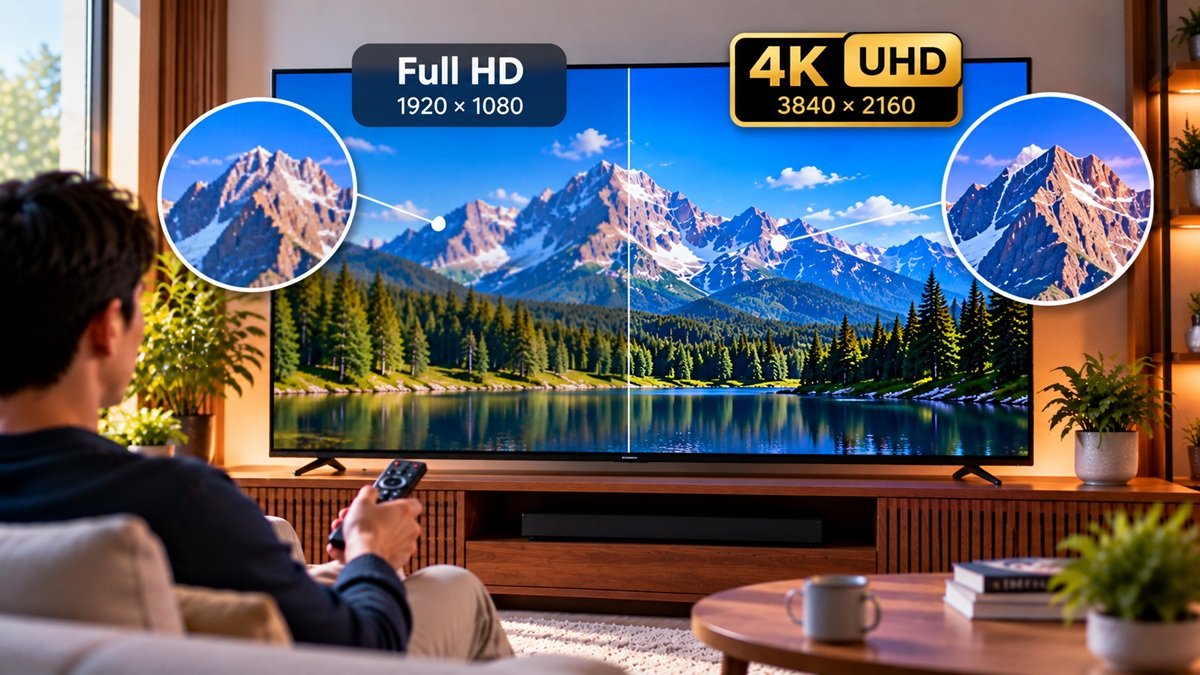
RTINGS says a display’s resolution on its own doesn’t matter all that much, but when you combine it with the size of the display and how close you are to it, it’s a strong indicator of how clear the image will be. It also puts it this way: “The resolution needed depends on the size and distance of the television.”
RTINGS gives one example. It says that someone with perfect vision sitting 10 feet from a 65-inch TV can’t tell a 1080p picture from a 4K one, and that the finer detail on the 4K TV only becomes noticeable at 8 feet and closer. That example is about a 65-inch TV and someone with perfect vision, and we don’t extend it to other sizes or eyesight.
Our own calculation from the widths and heights above: 3,840 × 2,160 is 8,294,400 pixels and 1,920 × 1,080 is 2,073,600 pixels, so a 4K screen has four times as many pixels as a 1080p screen. This is our own calculation, not a figure from RTINGS’ table, and it doesn’t tell you what you’ll see from your couch.
For how screen size and seating distance work out in a room, see our guide on what size TV to get for a living room.
Frequently Asked Questions
What is 4K UHD?
RTINGS lists 4K, 2160p, Ultra HD and UHD in the same table row: 3,840 pixels wide and 2,160 tall. It says 4K means nearly 4,000 horizontal pixels.
Is 4K the same as UHD?
RTINGS lists UHD and Ultra HD among 4K’s other names in its table. Its page doesn’t discuss any technical difference between them.
Does a higher-resolution TV mean a better TV?
RTINGS says that for the most part a higher resolution is better, but it doesn’t mean a higher-resolution TV is better than a lower-resolution one; it just means you can see more detail. It also says that if you watch TV from a far distance, you may not notice the difference between a 1080p and 4K TV, but those differences are easier to see if you sit up close.

Nridi
Editor, SignalVetted
This article does not report independent product testing.
✅ Based on RTINGS’ TV resolution page (updated Mar 19, 2026).