
How to Boost TV Antenna Signal
Last updated: October 2026
🕒 5 min read
Disclosure: This article does not contain affiliate or sponsored links. SignalVetted may still reference specific products or brands for informational purposes only.
If you are wondering how to boost TV antenna signal, the FCC guide this article relies on does not use that wording. It talks about improving reception, so that is the wording we use below, and the guide does not say that any device increases a signal.
The FCC says its guide gives information on TV antennas and tips for good quality reception of digital broadcasts. We did not run any tests or install an antenna ourselves, so the facts below are what the FCC says.
Table of Contents
How to Boost TV Antenna Signal: Start With the Right Antenna
According to the FCC, to receive digital TV signals from all stations in your area, your antenna needs to receive both VHF and UHF channels. As the FCC lists them, VHF channels are 2-13 and UHF channels are 14-36. It adds that some antennas give good reception of only VHF or only UHF channels.
As an example, the FCC says indoor rabbit ears usually need an additional wire loop or bowtie antenna to pick up UHF signals. It also says many antennas sold as HDTV antennas perform better at receiving UHF signals than at receiving VHF signals. Its suggestion is to check with retail consultants and consumer websites that any antenna you choose provides good reception of both. You can read the full guide in the FCC’s Antennas and Digital Television guide.
A converter box does not take the place of an antenna, the FCC adds. It says that even with a digital-to-analog converter box you still need an antenna, and that such boxes do not contain additional antennas or signal amplification.
Match the Antenna to Your Signal Strength
The FCC says the antennas it shows will work for the indicated signal strength in most instances, but may not work in all cases. The type of antenna needed at a specific location may vary depending on geographic location, the height at which the antenna is used and other local factors such as nearby buildings, trees, terrain or home construction.
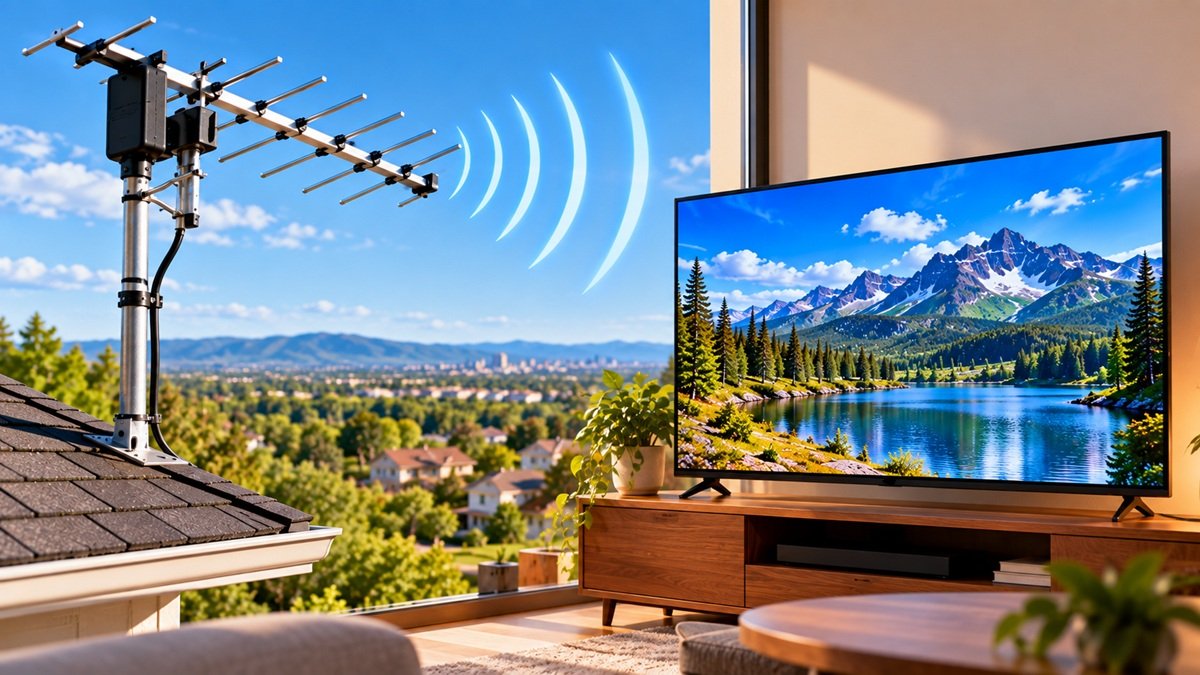
Generally, the FCC says, outdoor antennas get better reception than indoor antennas, and describes them as strongly recommended for the most reliable reception.
For strong signals, the FCC says simple indoor antennas may be sufficient. For moderate signals, it says a high-quality indoor antenna or an outdoor antenna may be appropriate. For weak signals, it says an outdoor antenna is appropriate.
Aim and Move the Antenna
The FCC says antennas typically need to be oriented, or aimed, toward the desired station. It says reception can often be improved just by changing the antenna’s location, even as little as a few inches. Its examples, which it says can often improve reception, are moving the antenna away from other objects or placing it higher or lower. The FCC advises moving the antenna slowly, so the signal received by the digital TV tuner has time to be displayed.
While you adjust the antenna, the FCC says it may help to use the signal strength meter on your converter box or digital TV, if it has one, to see whether your adjustments are improving the signal’s strength. It says the meter is usually reached through the menu on the remote control, and to consult your device’s owner’s manual for detailed instructions on how to access it.
After you adjust your antenna, the FCC says to do another channel scan. If you have a Samsung TV, our guide on how to scan channels on a Samsung TV lists Samsung’s steps.
For outdoor antennas, the FCC says a rotor that re-orients the antenna can improve performance, particularly when you are trying to receive stations that transmit from different locations.
Near a Broadcast Tower: When Overload May Be the Problem
The FCC says that if you are near a station’s broadcast tower, reception of that station, and of other stations, can be impeded by strong signal overload. If you suspect this is the case, it says you may want to remove any signal amplifiers you have, or try to install an attenuator to reduce the amount of signal coming to your converter box or digital TV.
If Some Stations Are Missing
The FCC says that not receiving certain digital stations does not necessarily mean there is a problem with your antenna or receiver. It suggests checking with the TV station to find out whether the station is planning changes that will improve reception.
What the FCC’s Page Does Not Tell You
In the text of the FCC’s page that we reviewed, several things are missing. It does not cover cables, splitters or connections, and it does not discuss interference; near a broadcast tower it uses the word overload, as described above. It does not say how far or how high to move or place an antenna, beyond the few inches mentioned above, or how close to a tower counts as near.
It also does not say what counts as a strong, moderate or weak signal. It does not explain how an amplifier works or when to add one, and it says only the one thing about rotors that is mentioned above. Those answers are not in the text we reviewed, and this article does not fill the gap.
Frequently Asked Questions
How to Boost TV Antenna Signal: Is an Outdoor Antenna Better?
Generally, according to the FCC, yes: outdoor antennas get better reception than indoor antennas, and the FCC describes them as strongly recommended for the most reliable reception. It adds that the type needed may vary with location and other local factors, and that simple indoor antennas may be sufficient for locations with strong signals.
Does moving an antenna help?
The FCC says reception can often be improved just by changing the antenna’s location, even as little as a few inches. It says to move the antenna slowly and to do another channel scan after you adjust it.
Why are some stations missing?
The FCC says that not receiving certain stations does not necessarily mean a problem with your antenna or receiver. It separately says that strong signal overload near a station’s broadcast tower can impede reception, and it suggests checking with the TV station about planned changes.

Nridi
Editor, SignalVetted
This article does not report independent product testing.
✅ Based on the FCC’s guide, “Antennas and Digital Television”.