OLED Panel Types Explained: WOLED vs QD-OLED
Last updated: September 2026
🕒 8 min read
Disclosure: This article does not contain affiliate or sponsored links. SignalVetted may still reference specific products or brands for informational purposes only.
Not every OLED panel is built the same way — and which construction a given TV uses doesn’t always match the assumption you’d make from the brand name on the box. With OLED panel types explained plainly, the two constructions doing almost all the work in the current 65-inch market are WOLED and QD-OLED, and they get to the same basic self-emissive result — pixels that make their own light — through meaningfully different means. If you’re still building your understanding of what OLED technology is at the most basic level before getting into panel-type distinctions, our explainer on what OLED TV technology actually is covers that foundational mechanism first, and this article assumes that groundwork already in place.
Once that base mechanism is clear, panel-type distinctions are the next layer of the picture, and they matter for a specific, practical reason covered further down: even the brand printed on the TV doesn’t always tell you which construction you’re actually getting. For where these panel types actually show up across current models once you understand the distinction below, our full OLED TV guide is the practical next stop.
Table of Contents
OLED Panel Types Explained: The Short Answer
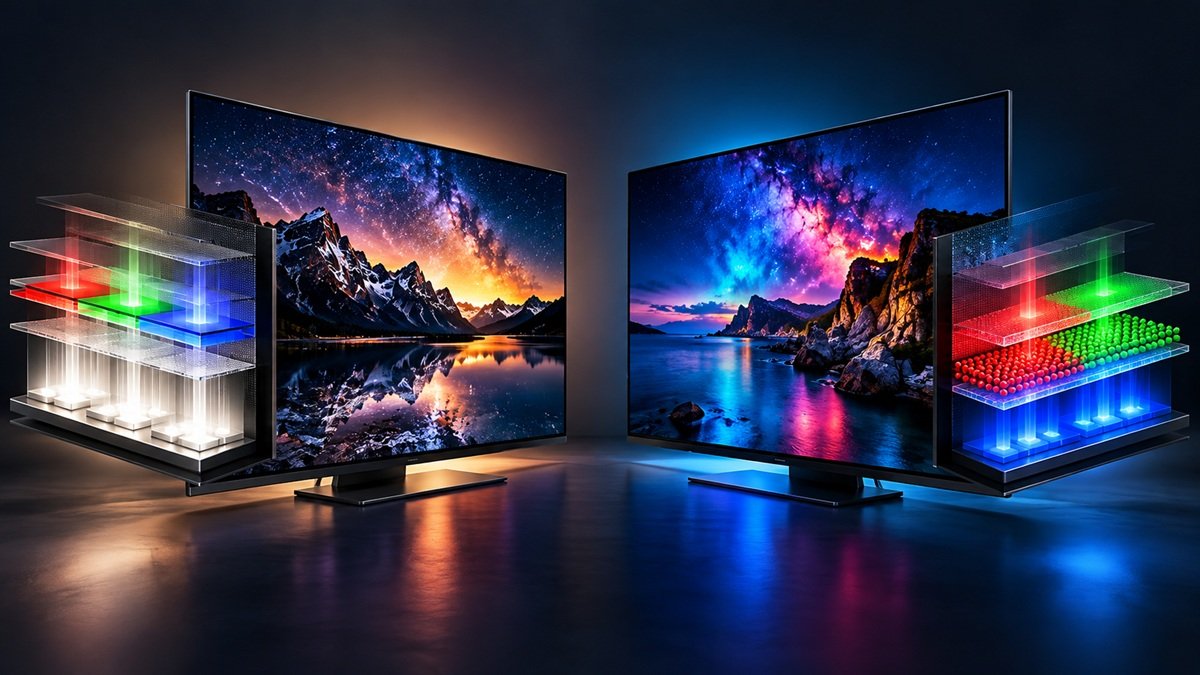
The two constructions that matter for almost every current 65-inch OLED TV are WOLED and QD-OLED, per RTINGS’ own WOLED vs. QD-OLED explainer. WOLED starts from a white-light-emitting OLED layer and then passes that white light through a color filter to produce red, green, and blue at each pixel — the color comes from filtering afterward, not from the emissive layer itself. QD-OLED instead starts from a blue-light-emitting OLED layer and uses a quantum-dot conversion layer to turn part of that blue light into red and green — the color comes from conversion, not filtering.
Both are still self-emissive, per-pixel-controlled OLED technology at the core, and both share the fundamental strengths that come with that (true blacks, wide viewing angles) — the difference is specifically in how each one gets from “the pixel is on” to “the pixel is showing this color.” For how much blue light TVs emit, see our guide on whether TVs emit blue light.
A third construction worth knowing about, though it’s less common at 65 inches specifically, is RGB Tandem — noted in this batch’s own product data for some larger 77- and 83-inch models. Rather than relying on a single emissive layer plus a filter or conversion step, a tandem construction stacks multiple emissive layers to boost brightness. The practical takeaway for most 65-inch shoppers is that WOLED and QD-OLED are the two constructions actually in play at that size, with RGB Tandem showing up mainly further up the size range.
OLED Panel Types Explained by Construction
How WOLED builds its picture
WOLED is the construction LG Display manufactures, and it’s the panel used across a wide range of OLED TVs sold under multiple brand names — brand and manufacturer aren’t the same thing here, which matters for the finding below. Based on manufacturer specification data, WOLED’s white-plus-filter approach has been refined over multiple generations to improve brightness and color volume, but the underlying two-step process (emit white, then filter to color) hasn’t changed.
How QD-OLED builds its picture
QD-OLED is Samsung Display’s construction, and its blue-plus-quantum-dot approach is a more recent entrant to the market than WOLED. Because it converts rather than filters, QD-OLED’s color volume and peak brightness characteristics differ somewhat from WOLED’s — a genuine construction-level difference, not just a marketing distinction between otherwise-identical panels.
Scenario-Based Guidance
If you’re deciding between LG and Samsung specifically and assuming that choice also settles which panel construction you’re getting, this batch’s own product data suggests that assumption is worth checking rather than taking for granted. Per this batch’s own product data, cross-referenced across two separate source files during this batch’s own review process — and now independently corroborated by TechRadar’s reporting on Samsung’s 2026 OLED panel sourcing and FlatpanelsHD’s independent 2026 Samsung lineup coverage — both of the 65-inch Samsung models reviewed in this batch — the 65S85H and the 65S90H — actually use LG-sourced WOLED panels, not Samsung Display’s own QD-OLED technology.
That finding is specific to these two reviewed models and shouldn’t be read as a settled claim about Samsung’s entire current OLED lineup — only as a concrete, now independently confirmed example that the brand-to-panel-type assumption doesn’t always hold, even for the specific models a shopper might be comparing.
If your scenario is narrower — you’ve already decided you want a QD-OLED panel specifically, for its particular color and brightness characteristics — the practical implication is that checking the panel construction of a specific model matters more than checking the brand name alone.
Common Misconceptions or Mistakes
Here’s an assumption that doesn’t survive contact with the data: that “Samsung OLED” always means QD-OLED and “LG OLED” always means WOLED, as if the two brands were locked to two separate, brand-exclusive technologies. As the independently confirmed finding above shows for this batch’s own reviewed models, that isn’t reliably true — panel sourcing and brand aren’t the same axis, even though it’s an easy assumption to make.
This is worth double-checking on a specific model rather than assumed from the brand alone, especially since panel sourcing can also change between generations of the same product line. If you’re specifically shopping Samsung’s current OLED lineup and want model-level detail rather than a general explainer, our Samsung OLED buying guide covers that ground directly.
A second, smaller misconception is treating panel construction as the single factor that determines picture quality. It’s a meaningful factor, but processor, upscaling, and refresh-rate ceiling — all things layered on top of whichever panel construction a given model uses — also shape real-world picture quality, sometimes more noticeably than the construction difference itself for ordinary viewing. A model with an older processor on a newer panel construction, or a newer processor paired with an older panel generation, can land closer together in real-world picture quality than the panel-type label alone would suggest — which is one more reason to check a specific model’s full spec sheet rather than stopping at “which panel type does this use.”
Frequently Asked Questions
What are the main OLED panel types explained simply?
The two constructions that matter for most current 65-inch OLED TVs are WOLED (a white-emitting layer filtered to color, made by LG Display) and QD-OLED (a blue-emitting layer converted to color via quantum dots, made by Samsung Display), per RTINGS’ explainer. A third construction, RGB Tandem, shows up mainly in larger 77- and 83-inch models rather than at 65 inches.
Does the TV brand always tell you which OLED panel type you’re getting?
Not reliably. Both Samsung models reviewed in this batch use LG-sourced WOLED panels rather than Samsung’s own QD-OLED technology — a specific, sourced example of brand and panel construction not lining up as commonly assumed, independently confirmed by TechRadar and FlatpanelsHD, though this finding is scoped to these two models rather than confirmed across Samsung’s whole lineup.
Is QD-OLED better than WOLED?
Neither construction is universally better — they differ in color volume and peak brightness characteristics because of how each produces color (filtering versus conversion), and which matters more depends on your own viewing priorities rather than the construction alone.

Nridi
Editor, SignalVetted
This article does not report independent product testing.
✅ Based on manufacturer specification data and this batch’s own cross-referenced product data.