
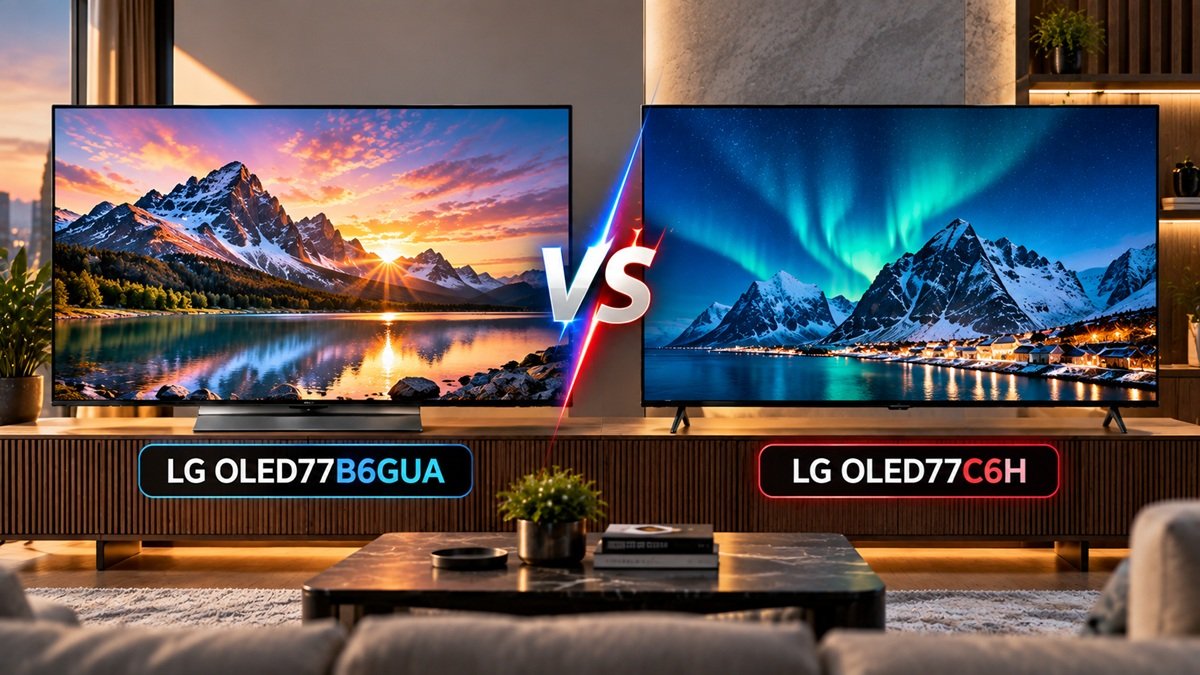
LG OLED77B6GUA vs LG OLED77C6H: Which 77-Inch OLED Fits You?
Last updated: October 2026
🕒 6 min read
Disclosure: As an affiliate partner, we may earn a commission from qualifying purchases made through the links in this article, at no extra cost to you.
In our reading of RTINGS’ reviews, the clearest difference between these two 77-inch LG OLEDs is the panel. RTINGS says the OLED77C6H uses a tandem OLED panel and the OLED77B6GUA uses a WOLED panel that LG calls “OLED SE”. The rest of this page covers what the reviews say about color, brightness and gaming features, and where each TV falls short.
This LG OLED77B6GUA vs LG OLED77C6H comparison puts two separate RTINGS reviews next to each other. It is not a side-by-side test. RTINGS tested the B6 at 65 inches and the C6H at 77 inches, and the reviews are dated differently: Sep 10, 2026 for the B6 and Apr 20, 2026 for the C6H, with a test bench update of Oct 02, 2026 shown on both pages. RTINGS says the B6 results are also valid for the 77-inch model, and its C6H review covers the 77-inch itself.
We haven’t tested either TV, and this page doesn’t compare what they cost. Where a statement comes from only one review, we say which.
Table of Contents
Quick Comparison
| Criterion | LG OLED77B6GUA | LG OLED77C6H |
|---|---|---|
| Unit RTINGS tested | 65-inch (OLED65B6GUA) | 77-inch (OLED77C6H) |
| Panel | WOLED panel LG calls “OLED SE” | Tandem OLED panel |
| SDR peak brightness (RTINGS’ wording) | Mediocre | Excellent |
| Maximum refresh rate | 120Hz | 165Hz |
| HDMI 2.1 ports | Four | Four |
Based on RTINGS’ separate reviews of the 65-inch B6 and the 77-inch C6H, using each page’s own wording. It is not a side-by-side test.
OLED77B6GUA vs OLED77C6H: Panel and Color
RTINGS’ review of the LG B6 OLED 2026 says the TV uses a newer WOLED panel that LG calls “OLED SE”. It says the panel isn’t as bright or as colorful as the tandem panel in the LG C6H OLED, with a weaker separation of colors. For the 65-inch B6 on its own, see our LG OLED65B6GUA review.
RTINGS’ review of the LG C6H OLED describes a tandem OLED panel with much better color separation than previous WOLED panels. It also says the panel still relies on a white subpixel. The B6 review also says, about its own panel, that the white subpixel boosts peak brightness but causes bright colors to be a bit washed out.
RTINGS’ C6H review calls that TV a considerable step up over entry-level OLEDs like the LG B6 OLED 2026 and the LG B6E OLED. For the C6H on its own, see our LG OLED77C6H review.
Color volume
RTINGS’ B6 review says color volume in SDR is great, and its C6H review says it is fantastic. For HDR, the B6 review calls color volume decent and the C6H review calls it excellent. These are RTINGS’ words about two different units, and most of the measurements behind them are marked Locked on the pages, so we don’t repeat any numbers.
HDR accuracy before calibration
RTINGS’ B6 review says the TV has fantastic accuracy in HDR before calibration. Its C6H review says accuracy in HDR before calibration is just okay. This is one place where the B6 review reads stronger than the C6H review.
HDR gradients
On HDR gradient handling, the B6 review says great, with some banding in dark shades of green that it calls not too distracting. The C6H review says superb, with almost no noticeable banding in any shade.
OLED77B6GUA vs OLED77C6H: Brightness and Glare
In SDR, RTINGS’ B6 review calls peak brightness mediocre. It says the TV isn’t bright enough to overcome significant glare during the day, especially when more of the screen is bright, like when watching sports. Its C6H review calls SDR peak brightness excellent and says the TV is bright enough to overcome glare in a moderately-lit room.
In HDR, the B6 review calls peak brightness decent, while the C6H review calls brightness excellent.
In its SDR brightness section, RTINGS’ C6H review says the TV’s automatic brightness limiter significantly reduces peak brightness when more of the screen is bright at once, like when watching sports.
The C6H review calls direct reflection handling mediocre, and the B6 review says the TV’s glossy coating is ineffective at reducing glare from bright, mirror-like reflections.
Gaming Features and Refresh Rate
These are RTINGS’ stated features for each TV, not measurements we made. The B6 review says the TV delivers incredibly clear motion at its maximum refresh rate of 120Hz. It also says the TV supports the full 48Gbps bandwidth of HDMI 2.1 on all four HDMI ports and all three types of variable refresh rate technology.
The C6H review says the TV supports all common resolutions up to 4k @ 165Hz, and the full 48Gbps bandwidth of HDMI 2.1 on all four HDMI ports. It says the TV supports FreeSync and HDMI Forum VRR and is certified as G-SYNC compatible, ensuring a nearly tear-free gaming experience from any VRR-enabled source. The B6 review says “all three types” without naming them in that sentence, while the C6H review names FreeSync, HDMI Forum VRR and G-SYNC compatibility, so we don’t read the two sentences as a difference in support.
For PC use, the two reviews note different things about text. The B6 review says the TV’s subpixel structure helps improve text clarity from a PC, since the red, green and blue subpixels are in the correct order a PC expects. The C6H review says chroma 4:4:4 helps with text clarity from a PC, but also says the TV has minor issues displaying text on Windows because ClearType isn’t well optimized to non-RGB subpixel layouts. It adds that LG has restructured the subpixels so text looks a bit better than on previous generations.
Our Reading: LG OLED77B6GUA
Our inference, not a RTINGS conclusion: if your 77-inch OLED will mostly be watched with the lights low, the brightness limits RTINGS describes for the B6 may matter less to you. RTINGS’ B6 review says the TV isn’t bright enough to overcome significant glare during the day, especially when more of the screen is bright.
The B6 review also has points in its favor: fantastic HDR accuracy before calibration and a subpixel structure it says helps text clarity from a PC. The trade-offs, per RTINGS, are mediocre SDR peak brightness, a weaker separation of colors than the tandem panel, and HDR peak brightness it calls decent.
Our Reading: LG OLED77C6H
Our inference, not a RTINGS conclusion: on brightness wording alone the C6H review reads stronger, but the same review says its mediocre direct reflection handling limits visibility in a bright room and glare can still be a bit distracting. RTINGS says the TV is bright enough to overcome glare in a moderately-lit room and calls brightness excellent in both SDR and HDR. That wording is about a moderately-lit room, so don’t read it as a promise for every bright room.
The trade-offs, per RTINGS, are the brightness limiter when more of the screen is bright, mediocre direct reflection handling, HDR accuracy before calibration that is just okay, and minor text issues on Windows.
Final Verdict
Our reading of RTINGS’ two reviews is a split rather than a sweep. The C6H review gives stronger wording on color and brightness, while the B6 review gives stronger wording on HDR accuracy before calibration, and the C6H review flags a brightness limiter and mediocre direct reflection handling.
Which of those points matters depends on your room and how you use the TV; this page doesn’t recommend either model. Cost isn’t covered here, and the two TVs weren’t tested side by side.
Frequently Asked Questions
What is the main difference between the LG OLED77B6GUA vs LG OLED77C6H?
In our reading of RTINGS’ reviews, it is the panel. RTINGS says the B6 uses a WOLED panel that LG calls “OLED SE” and the C6H uses a tandem OLED panel. Its wording on SDR peak brightness is mediocre for the B6 and excellent for the C6H. This page doesn’t compare cost.
Do RTINGS’ results for the B6 apply to the 77-inch model?
RTINGS tested the 65-inch LG B6 and says the results are also valid for the 48-inch, 55-inch, 77-inch and 83-inch models. For the C6H it tested the 77-inch and says the results are also valid for the 83-inch size. It adds that the smaller C6 sizes use an older OLED-EX panel structure and don’t perform the same, so the C6H findings here don’t apply to them.
What do both RTINGS reviews say the two TVs have in common?
Both reviews say the TV supports Dolby Vision but not the newer Dolby Vision 2, and doesn’t support any DTS audio formats commonly used on physical media. Both also say that, like all OLEDs, the TV is susceptible to permanent burn-in from cumulative exposure to static elements like a channel logo or desktop interface. RTINGS says it doesn’t expect that to be an issue for most people who watch varied content, and notes built-in features to minimize the risk, including Pixel Shift and Panel Refresh.
Links to both TVs (affiliate links):
🛒 Check LG OLED77B6GUA (paid link)
🛒 Check LG OLED77C6H (paid link)

Nridi
Editor, SignalVetted
SignalVetted has not independently tested these TVs.
✅ Based on RTINGS’ reviews of the LG B6 OLED 2026 and LG C6H OLED.