OLED TV vs Projector: How the LG C6 Compares to a Home Theater Projector
Last updated: September 2026
🕒 7 min read
Disclosure: This article does not contain affiliate or sponsored links. SignalVetted may still reference specific products or brands for informational purposes only.
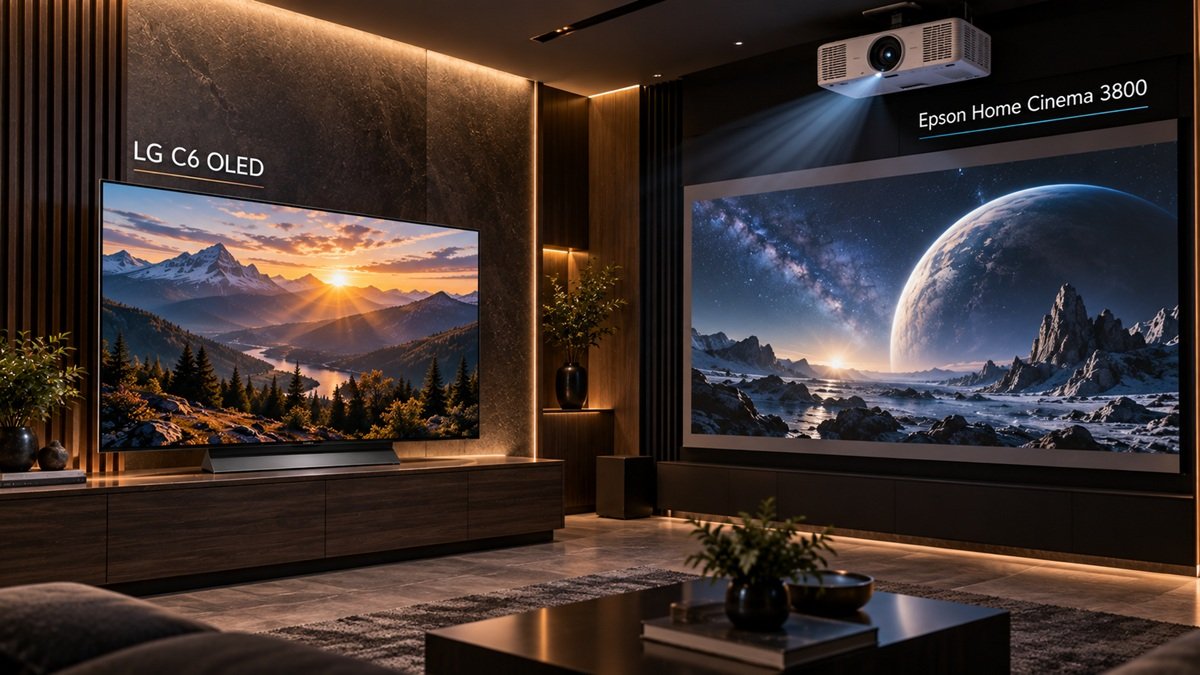
OLED TV vs projector isn’t a question any single source has answered directly for us, so we’re upfront about what this page actually is: our own side-by-side reading of two specific, currently-reviewed products — the LG C6 OLED 2026 and the Epson Home Cinema 3800 projector — built from two independently published RTINGS reviews rather than one RTINGS verdict that already compares them.
Treat this as a worked example, not a category verdict. Where we describe how these two display technologies trade off against each other, we label it clearly as our own reading. Where we describe a single product’s own tested behavior, that’s attributed to its actual source — RTINGS’ review of the Epson 3800, or facts reported in our LG OLED65C6 review.
Table of Contents
OLED TV vs Projector: The Short Answer
Our reading: the LG C6’s advantage is consistency — the same picture quality whether the room is dark or lit, with no setup beyond placing the TV. The Epson 3800’s advantage is scale — a much bigger image for the money, provided the room can be darkened when it matters. Neither product comes out ahead outright; which one serves you better depends on your room and how much you value screen size versus a picture that holds up in daylight.
Our reading, based on RTINGS’ individual reviews of each product
Overall winner: none. This is a trade-off between two different display technologies, not a head-to-head test result.
By use case: LG C6 for a room with any ambient light, or if you want to sit down and watch without setup; Epson 3800 for a dedicated, darkenable space where a large screen matters more than daytime usability.
Conditions: the Epson 3800’s own RTINGS verdict notes its contrast drops and images look flatter as scenes get brighter — that limitation is specific to this projector, not a general claim about every projector.
Scope: What This Comparison Covers
This page compares exactly two named products: the LG C6 OLED 2026 (65-inch unit, as reviewed) and the Epson Home Cinema 3800 (an upper-mid-range 4K HDR 3LCD home-theater projector in Epson’s lineup). It is not a claim about OLED TVs or projectors as categories, and it excludes laser projectors, ultra-short-throw models, and Epson’s own budget and premium tiers. The RTINGS review of the Epson 3800 used as evidence here was originally published February 13, 2024, with its test bench updated July 28, 2026 — recent, but not the same vintage as some of the freshest evidence used elsewhere on this site. LG C6 facts are reused from our already-published LG OLED65C6 review and were not re-researched for this page.
Picture Quality and Contrast
The LG C6 uses a self-emissive OLED panel, meaning each pixel produces and controls its own light rather than relying on a separate backlight — a structural difference from any projected image, and one already established in our LG OLED65C6 review, which also confirms the C6 supports Dolby Vision. We hold no separate RTINGS lab dataset for the C6’s picture quality in this session, so we’re not restating numeric test results for it here.
For the Epson 3800, RTINGS’ own review describes contrast as strongest in dark scenes, dropping as scenes get brighter — so images with a lot of bright content look flatter. RTINGS also describes the 3800’s colors as natural and accurate out of the box, though not especially rich or bold, and notes it’s free of rainbow artifacts, though camera pans can look jumpy when a streaming device outputs at 60Hz. RTINGS does not publish the projector’s numeric brightness, contrast, or color-accuracy figures without a paid membership, so none appear here.
Our reading: the practical difference is that the LG C6’s picture quality doesn’t depend on how dark the room is, while the Epson 3800’s does — a trade-off in how the technologies work, not a claim that one is better made.
Room Lighting and Environment
Our reading: this is the biggest practical difference between the two. RTINGS’ own verdict on the Epson 3800 already shows the pattern: contrast and picture quality hold up well in a dark room but look flatter as ambient or on-screen brightness increases. A projected image is inherently more sensitive to room light than a self-emissive OLED panel, which does not depend on a projection surface or a darkened space to produce its picture. This isn’t a claim that OLED TVs are immune to glare or reflections in general — it’s specific to the fact that a projector needs a controllable-light environment to show what the Epson 3800 is actually capable of, and the LG C6 doesn’t have that requirement at all.
Screen Size and Installation
The Epson 3800 is designed to scale: RTINGS’ spec sheet lists roughly an 80-inch image at about 8 feet of throw distance, 100 inches at about 10 feet, and 120 inches at about 12 feet, with manual focus and manual lens-shift (roughly ±60% vertical, ±24% horizontal) to help position the image without moving the projector itself. That flexibility comes with a real installation requirement — a projection surface, a throw distance that fits the room, and ideally a mount or shelf placement RTINGS’ own guidance treats as standard for this class of projector.
The LG C6, as reviewed, is a fixed 65-inch panel with no throw-distance planning or projection surface needed — it goes wherever a TV normally goes. Our reading: if you want a screen larger than typical TV sizes without buying an oversized (and expensive) OLED panel, the Epson 3800’s scalability is the practical reason to consider a projector at all; if simple placement matters more than maximum size, the LG C6 removes an entire installation step.
Audio, Ports, and Extras
The Epson 3800 includes two HDMI 2.0 ports supporting 4K at 60Hz for gaming, Bluetooth with aptX support for wireless audio, and two integrated 10-watt speakers — enough for casual use, though RTINGS’ own review doesn’t position them as a home-theater sound solution on their own. Our LG OLED65C6 review already documents the C6’s gaming feature set: a 165Hz refresh ceiling with VRR and ALLM support, per LG’s official specifications and RTINGS’ own testing cited there — reaching the full 165Hz ceiling on either product depends on a source and cable capable of it.
Where This Comparison Stops
This page is scoped to two specific products — the LG C6 OLED 2026 and the Epson Home Cinema 3800 — and the trade-offs described above are ours, built from each product’s own independently published RTINGS review, not a single source’s head-to-head verdict. It does not cover the projector’s numeric test results, which RTINGS gates behind membership and which we have not estimated. It doesn’t extend to other Epson projector tiers (budget or premium), other projector brands, or other LG OLED sizes or model years. For the LG side specifically, our LG OLED65C6 review goes deeper on that exact model. No equivalent SignalVetted review of the Epson 3800 exists yet, so there’s no second internal link to offer on the projector side.
Frequently Asked Questions
Is an OLED TV or a projector better for a home theater?
Our reading: it depends on the room. The LG C6 holds its picture quality regardless of ambient light and needs no installation. The Epson 3800 can deliver a much larger image for the money, but its own RTINGS verdict shows contrast dropping as scenes get brighter — so it performs best in a room you can darken. This answer is scoped to these two specific products, not OLED TVs or projectors as categories.
Does a projector need a dark room to look good?
For the Epson Home Cinema 3800, yes in practical terms — RTINGS’ own verdict describes its contrast as strongest in dark scenes and flatter as scenes get brighter, which is a room-lighting-sensitive result, not a fixed picture quality.
Does this comparison apply to every OLED TV or every projector?
No. It compares one specific LG OLED model and one specific Epson projector model. It doesn’t establish anything about other OLED TVs, other projector brands, or other projectors in Epson’s own lineup.

Nridi
Editor, SignalVetted
SignalVetted has not independently tested these products.
✅ Based on the sources named on this page.