
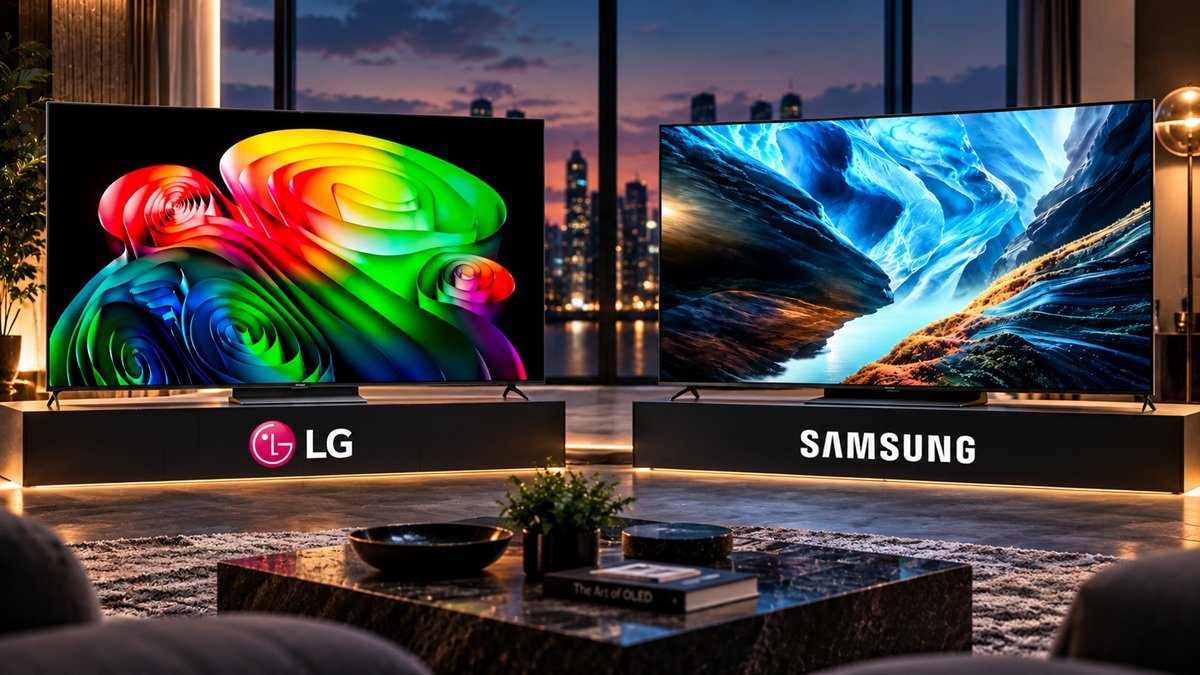
Best OLED TVs Under $1000: LG vs. Samsung Budget Picks
Last updated: September 2026
🕒 10 min read
Disclosure: As an affiliate partner, we may earn a commission from qualifying purchases made through the links in this article, at no extra cost to you.
OLED used to mean paying a premium no matter what. That’s changed — both LG and Samsung now sell an entry-tier 65-inch OLED that gets you the same fundamental contrast and black-level advantage over LED/QLED, for meaningfully less than their mid-flagship models cost. The question at this price point isn’t whether OLED is worth it; it’s which brand’s budget pick fits your setup, and what exactly you’re giving up by not paying for the tier above it. We put LG’s OLED65B6GUA and Samsung’s 65S85H side by side to answer both.
Table of Contents
Quick Picks
| Category | Pick | Best For |
|---|---|---|
| Best LG Pick Under $1,000 | LG OLED65B6GUA | Buyers already in LG’s ecosystem, or who don’t need the newest processor |
| Best Samsung Pick Under $1,000 | Samsung 65S85H | Buyers already in Samsung’s ecosystem, or who don’t need the newest processor |
How to Decide: LG or Samsung at the Budget Tier
Once you’ve decided OLED matters more to you than saving further on an LED or QLED set, this decision comes down to two things: brand ecosystem, and how much you’re willing to give up versus each brand’s own mid-flagship tier. Both picks here use the same panel technology as their respective brand’s more expensive models — the difference is processor generation and refresh-rate ceiling, not core picture quality. If you’re not sure OLED itself is the right call before even reaching this budget-tier decision, our investigation into whether OLED is worth it in 2026 is the place to start first.
From there, the honest question is how much of the mid-flagship tier’s extra capability you’d actually use. Neither budget pick here is a compromised version of OLED — they’re the same fundamental display technology at a lower price, with less processing headroom and a lower refresh-rate ceiling as the trade.
It’s worth being specific about what “budget” means in this context, since the word tends to imply a lesser product across the board. In OLED specifically, the price gap between a brand’s budget and mid-flagship tier is driven almost entirely by the processor chip and the refresh-rate ceiling it supports — not by a cheaper panel, a smaller color gamut, or reduced contrast. That’s meaningfully different from budget tiers in other TV categories, like entry-level LED sets, where a lower price often does mean a truly lesser panel. Here, you’re paying less for less processing power, not for less display technology.
There’s also a practical reason both brands price their budget OLED tier this way rather than cutting panel quality: OLED’s manufacturing cost is dominated by the panel itself, not the surrounding electronics. Once a brand has committed to selling OLED at a given screen size at all, differentiating tiers by processor and feature set is a more sensible way to hit a lower price point than sourcing a second, cheaper panel supply chain just for the budget model. That’s good news for anyone shopping this price point specifically — it means the “budget” label describes the electronics around the screen, not a compromise in the screen itself.
Best LG Pick Under $1,000: LG OLED65B6GUA
The OLED65B6GUA is LG’s entry point into its 2026 65-inch OLED lineup, built around the Alpha 8 processor rather than the Alpha 11 Gen3 found in LG’s mid-flagship model. Based on LG’s own product page for the OLED65B6GUA, it still supports Dolby Vision and runs the same webOS smart-TV platform LG uses across its whole 65-inch range — stepping down to this tier doesn’t cost you any software features.
What you’re giving up: a 120Hz refresh-rate ceiling, rather than the 165Hz available one tier up, and the Alpha 8’s simpler upscaling approach compared to the newer chip. For a household that watches more than it games competitively, that gap is easy to live with — the underlying panel and picture quality are the same LG WOLED technology either way.
Where the Alpha 8’s simpler processing shows up most is with lower-resolution or heavily compressed sources — older cable broadcasts, some streaming libraries that don’t deliver native 4K, or older Blu-rays. On a well-mastered native 4K stream, the practical gap between this chip and LG’s newer processor narrows considerably, since there’s comparatively little upscaling work for either chip to do. If most of what you watch already arrives in good-quality 4K, this is the tier where that fact matters most in your favor.
It’s also worth naming a use case where this pick actually edges out the tier above it, rather than simply matching it minus features: as a second TV — a bedroom, a home office, a guest room — where the goal is real OLED contrast at the lowest reasonable entry cost, not the highest possible spec sheet. In that context, the Alpha 8’s more modest processing isn’t a compromise you’re settling for; it’s capability you’d likely have left unused on a primary living-room set anyway.
🛒 Check LG OLED65B6GUA (paid link)
Best Samsung Pick Under $1,000: Samsung 65S85H
The 65S85H is Samsung’s cheapest 65-inch OLED, running the older NQ4 AI Gen2 processor rather than the Gen3 chip in Samsung’s mid-flagship model. Its panel is LG Display-sourced WOLED — the same panel source Samsung’s mid-flagship 65S90H uses, not a separate, lesser display technology reserved for the budget tier, per FlatpanelsHD’s independent 2026 Samsung lineup coverage.
The gap here mirrors LG’s side: a 120Hz refresh ceiling instead of 165Hz, and an older processor generation with less upscaling headroom for lower-resolution sources. Samsung’s Tizen OS and SmartThings integration carry over unchanged from the mid-flagship model, so — same as LG’s budget tier — you’re not losing software capability by choosing this price point, only processing power and refresh-rate ceiling.
One notable absence at this tier: the 65S90H’s Glare Free coating isn’t included on the 65S85H, per Samsung’s own 65S85H product page. If your room fights glare from a window or overhead lighting, that’s a difference you’ll notice on ordinary nights, not just on a spec sheet — worth weighing specifically if bright-room viewing is a regular part of your setup, separate from the processor and refresh-rate trade already covered above.
On the processor side specifically, the same logic that applies to LG’s Alpha 8 applies here to Samsung’s Gen2 chip: the gap versus the newer Gen3 processor is most visible on lower-resolution or heavily compressed sources, and narrows considerably on well-mastered native 4K content. If your primary source is a modern streaming service delivering genuine 4K, that’s exactly the scenario where this processor’s more modest upscaling matters least.
🛒 Check Samsung 65S85H (paid link)
Budget vs Premium: What You Actually Get
The clearest way to see what the extra money buys at the tier above this one is to look at a direct pairing: our Samsung 65S85H vs 65S90H comparison breaks down the processor, refresh-rate, and glare-coating gap between Samsung’s budget and mid-flagship models specifically. The short version applies to LG’s lineup too, model-for-model: a newer processor generation, a higher refresh-rate ceiling, and — on Samsung’s side specifically — a glare-reducing coating not included at the budget tier. None of that changes the underlying panel technology; it changes how much processing headroom and refresh capability you’re paying for.
If you want the fuller picture of exactly what the 65S85H gives up at this price point, our full Samsung 65S85H review covers it in more depth than a comparison table can.
The same pattern holds on LG’s side, even without a dedicated comparison article covering it here: the OLED65C6 adds a newer processor, a higher refresh ceiling, and slightly more refined upscaling over the OLED65B6GUA, without changing the underlying panel technology. The practical question for both brands is identical — does your use case actually draw on the extra processing headroom, or would that money be better spent elsewhere, like a soundbar or a better viewing setup?
Worth naming directly: the price gap between a brand’s budget and mid-flagship tier tends to be larger than the gap between the two brands’ budget picks against each other. In other words, if you’re on a strict budget, the bigger savings usually come from staying at the entry tier within either brand, not from picking whichever brand happens to be cheaper at the entry tier that week. Brand and ecosystem fit are the more durable reasons to choose one over the other at this price point, since the picture-quality gap between LG’s and Samsung’s budget picks is already narrow.
Who Should Buy What
If you’re deciding whether the step up to LG’s mid-flagship tier is worth it over this budget pick, our investigation into upgrading to LG OLED for 2026 walks through that decision directly, evidence first rather than assuming the pricier tier is automatically the better buy.
Buyers who’ve already decided LG’s budget tier is the right call, and want the fuller review before purchasing, should read our full LG OLED65B6GUA review for the complete picture beyond this guide’s side-by-side framing.
For either brand, the same rule of thumb applies: if your viewing is mostly movies, shows, and everyday TV rather than competitive gaming, the budget tier gets you the real OLED picture-quality advantage without paying for refresh-rate headroom you’re unlikely to use. It’s also a reasonable pick for a secondary room — a bedroom, a den, a guest space — where you want genuine OLED contrast without dedicating your largest budget to a screen you’ll spend less time in front of.
Final Recommendation
Both picks here deliver the same core OLED advantage over LED and QLED at this price point — the choice between them comes down to which brand’s ecosystem you’re already in, or lean toward, more than any meaningful gap in picture quality. If you’re weighing this decision purely on use case: heavy gamers on high-refresh hardware are the group most likely to regret skipping the mid-flagship tier, while everyone else is already well served by either budget pick here. For the wider context of how these budget picks compare against each brand’s mid-flagship tier, our full OLED TV guide covers all four models together.
Frequently Asked Questions
What’s the best OLED TVs under $1000?
At 65 inches, the two strongest options under $1,000 are the LG OLED65B6GUA and the Samsung 65S85H — both use the same panel technology as their brand’s pricier tier, trading processor generation and refresh-rate ceiling for a lower price.
Is a budget OLED TV worth it compared to a mid-flagship one?
For viewers who mostly watch movies and shows rather than game competitively, yes — the core picture quality is the same, and the mid-flagship tier’s extra processing power and refresh-rate headroom matter far less outside of gaming.
Do budget OLED TVs use a worse panel than premium models?
Not in this case — both the LG OLED65B6GUA and Samsung 65S85H use the same panel source as their brand’s mid-flagship model. The difference is processor generation and refresh-rate ceiling, not the underlying display technology.
Which is better for gaming, the budget or mid-flagship tier?
The mid-flagship tier, if you can push frame rates above 120 on a current-generation console or PC — its higher refresh-rate ceiling makes a noticeable difference there. If your gaming is casual or console-based at standard frame rates, the budget tier’s 120Hz ceiling already covers what you need.

Nridi
Editor, SignalVetted
SignalVetted has not independently tested these TVs.
✅ Based on spec analysis and the sources named on this page.