
Do TVs Emit Blue Light?
Last updated: October 2026
🕒 4 min read
Disclosure: This article does not contain affiliate or sponsored links. SignalVetted may still reference specific products or brands for informational purposes only.
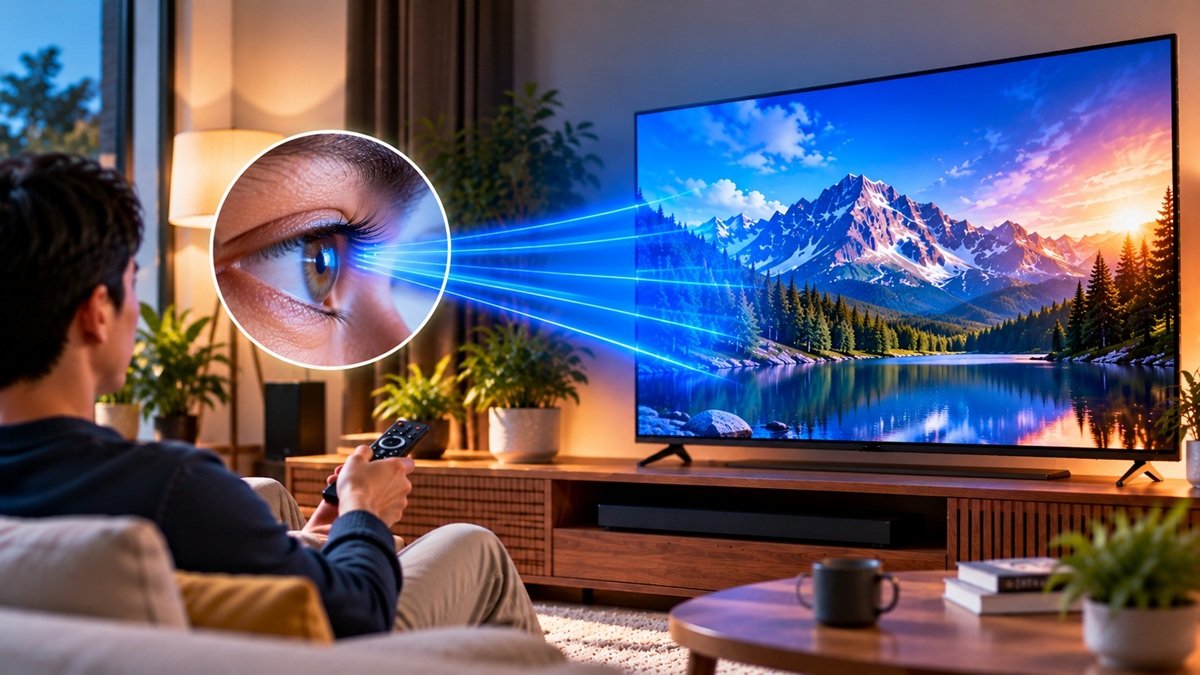
If you’ve read about blue light from phones and tablets, you may wonder whether your TV gives off the same thing. So, do TVs emit blue light? According to RTINGS, yes: however a TV makes its light, it still produces blue light. How much of it matters, and for what, depends on the question: RTINGS says studies are split on eyes, with more consensus on sleep.
This guide follows RTINGS’s investigation of TV blue light. We did not run any measurements ourselves. It covers what RTINGS found, what it says about eyes and sleep, and what it says about reducing blue light. It does not compare individual TVs or give health advice.
Table of Contents
Do TVs Emit Blue Light? How TVs Make It
What Blue Light Is
RTINGS describes blue light as the part of the visible spectrum with a wavelength of about 380 to 500 nanometers. It has one of the shortest wavelengths we can see, which makes it one of the highest-energy colors in visible light.
LED and OLED Both Produce It
RTINGS says most wide-color-gamut LED TVs make blue light in the backlight and nowhere else. That blue is then converted into other colors with color filters or quantum dots.
Some TVs, especially lower-end ones, use white LEDs instead. RTINGS explains that a white LED is still a blue LED, with a phosphor converting part of the blue light, and the light usually still has a very strong blue peak.
OLED TVs come in two main types, WOLED and QD-OLED. RTINGS says both show a strong blue peak in its example charts. Its conclusion is that no matter how a TV makes its light, whether blue or white at the source, it still produces blue light. For how the two constructions differ, see our explainer on OLED panel types.
RTINGS adds that this blue light plays an important role in a TV’s color accuracy, so manufacturers can’t simply eliminate it.
What RTINGS Measured
RTINGS’s page (Updated Feb 18, 2026) says it measured the spectral output of 83 TVs, tested on its 2.0.1 and 2.1 test methodologies. Each TV showed a white slide after RTINGS calibrated it to 100 nits, and RTINGS measured the light with a Colorimetry Research CR-250 from 380 to 780 nanometers in 2-nanometer steps.
RTINGS then focused on 400 to 500 nanometers and looked at how much of that blue output falls in two ranges: 415 to 455 nanometers, the range it calls the harmful range, and 460 to 480 nanometers, the range it ties to the circadian rhythm.
RTINGS says it compares OLED and LED technology rather than individual models, and it does not look at colorimetry (color accuracy) in this investigation. You can read the full write-up in RTINGS’s TV blue light investigation.
LED and OLED Results
RTINGS’s percentages are shares: the portion of a TV’s own blue light that falls in each range. A share tells you how that TV divides its blue light between ranges. It does not tell you how much blue light the TV puts out in total.
LED TVs
RTINGS’s LED results (Updated Feb 18, 2026) cover 64 TVs. On average, 64% of their blue light falls in the range RTINGS calls the harmful range, and individual TVs vary between 48% and 75%.
In the circadian range the average is 17%, and RTINGS says the impact on the circadian rhythm seems minor. It also says most of these TVs have their blue peak at around 446 to 448 nanometers.
OLED TVs
RTINGS reports OLED TVs separately. In its OLED results (Updated Feb 18, 2026), RTINGS says OLED TVs appear to put a significantly smaller share of their blue light in the range RTINGS calls the harmful range than LED TVs do, although RTINGS says they still emit some in that range. RTINGS also says OLED TVs put a larger share in the circadian range than LED TVs do.
Blue Light and Your Eyes: What RTINGS Says
RTINGS says the amount of blue light from a TV is minimal compared with the sun’s, and that studies are split on how much damage it does to the eye, or whether it does any at all. It adds that scientists are not universally agreed on the possible harmful effects.
According to RTINGS, light in the 415 to 455 nanometer range is thought to be the most likely to cause eye damage. RTINGS says light in that range can pass through the cornea and lens to the retina, and it names short-term issues such as dry eyes and general discomfort.
It also says some studies suggest long-term exposure might cause greater issues, such as cataracts or age-related macular degeneration. We have not read those studies ourselves. This is RTINGS’s summary of them, not our own finding, and it is not health advice.
Blue Light and Sleep: What RTINGS Says
RTINGS says there is more of a consensus on sleep than on eyes. According to RTINGS, studies show that blue light in the 460 to 480 nanometer range can reset the circadian melatonin rhythm and suppress the release of melatonin, which can disrupt the body’s internal sleep schedule.
In its conclusion (Updated Feb 18, 2026), RTINGS says LED TVs put the smaller share of their blue light in the circadian range, while OLED TVs might have a greater impact on sleep cycles. For a bedroom TV, RTINGS says it seems like LED TVs might be the best choice.
Reducing Blue Light on a TV: What RTINGS Says
RTINGS’s page (Updated Feb 18, 2026) says almost all TVs offer a Night Mode or Reduce Blue Light setting designed to reduce the blue light the TV emits. The trade-off, RTINGS says, is that the setting forces the TV into a warmer color temperature, so the picture is less accurate.
RTINGS says it found blue light filters on monitors very effective, and it expects the feature on TVs to be just as effective. That is RTINGS’s expectation for TVs, not a TV test result.
The names and locations of this setting vary by brand and model, so check your TV’s settings menu for a blue light or night mode option.
Frequently Asked Questions
Do TVs emit blue light?
According to RTINGS, yes. It says that however a TV makes its light, whether blue or white at the source, it still produces blue light.
Does blue light from a TV affect your eyes?
RTINGS says studies are split on how much damage blue light from a TV does, or whether it does any, and that the amount from a TV is minimal compared with the sun’s. It says light in the 415 to 455 nanometer range is thought to be the most likely to cause eye damage.
Does blue light from a TV affect sleep?
RTINGS says there is more of a consensus here. It says studies show that blue light in the 460 to 480 nanometer range can suppress melatonin and disrupt the sleep schedule. For a bedroom TV, RTINGS says it seems like LED TVs might be the best choice.

Nridi
Editor, SignalVetted
This article does not report independent product testing.
✅ Based on RTINGS’s TV blue light investigation (page updated Feb 18, 2026).